

While the Pentagon is "celebrating" the US Congress's decision not to proceed with the impeachment process against War Secretary Pete Hegseth, a veritable "civil war" has broken out in the US over the next moves in the war with Iran. Democrats argue they plan to use federal government funding as a weapon to halt military operations at a time when the US finds itself in a diplomatic and military deadlock in the Persian Gulf. It is characteristic that Iranian terror has reached even the US, where intelligence services have "evacuated" US Treasury Secretary Scott Bessent due to death threats, while an alert has been issued for American citizens in Saudi Arabia as the American embassy warns of the risk of attacks.
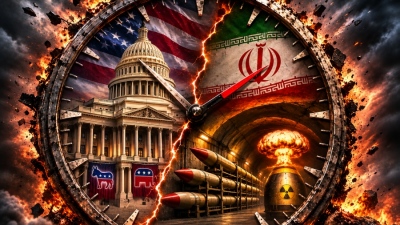
For its part, Iran, after declaring that there will be no diplomatic solution unless its seven conditions are accepted and after revealing a new underground "missile city", warns that in the event of a new war, its opponents will face "one surprise after another". Amidst this explosive scenery, Russia is strengthening its diplomatic support for Tehran, underlining that any agreement with the US must be based on mutual respect. However, the most worrying development is recorded within Iran itself, where hardline circles are increasingly openly raising the issue of abandoning the Non-Proliferation Treaty and changing the country's nuclear doctrine, even in the direction of building a nuclear bomb. These developments confirm the geopolitical chaos prevailing in the broader Middle East region.
IRGC shock warning: One surprise after another awaits you
The Chief of Staff of the Armed Forces of Iran, Major General Ali Abdollahi, warned the country's opponents that, in the event of a new war, they will face successive surprises. General Abdollahi issued the warning during a ceremony presenting a new underground missile facility, known as a "missile city", belonging to the Islamic Revolutionary Guard Corps Aerospace Force. "The United States has never used in any other war and within a corresponding timeframe such a large quantity of ammunition and military equipment, particularly such advanced weapon systems. In the next war, surprises will be unveiled one after another," Abdollahi warned. Commenting on recent statements by Israeli Prime Minister Benjamin Netanyahu, who argued that either Israel must destroy Iran or Iran will destroy Israel, Abdollahi stated that this specific stance is nothing new. "We will certainly destroy them," he stated, adding that Israel and the US have already tested their capabilities and have engaged in the conflict using all means at their disposal without managing to achieve their goals.
Political "civil war" in Washington
The internal confrontation in the US is taking on the characteristics of a frontal clash as Democrats seek to limit the Trump administration's ability to continue operations against Iran. Democratic Senator Adam Schiff announced that his party plans to utilize impending federal government funding negotiations to exert pressure for ending the war. According to Schiff, the funding bill expires on December 11, creating a critical political milestone. "This gives us the opportunity to implement one of the demands expressed by voters: ending the war in Iran," Schiff stated, emphasizing that the conflict was never approved by Congress nor requested by the American people, while accusing the administration of constantly changing the justifications for military involvement. In his estimation, operations not only failed to weaken Tehran but strengthened its position in the Strait of Hormuz.
December 11
The battle over the federal budget may turn into a decisive field of conflict between the White House and Congress. The American military presence in the Middle East remains massive, including three carrier strike groups, a large number of sailors, and extensive support, supply, and aviation operations personnel. Maintaining this force requires continuous funding, a fact of particular political significance if Congress refuses to cover operations of this scale with the sole objective of maintaining the status quo. The balance is expected to shift even further in January 2027 when Democrats take control of both houses of Congress. For now, however, there are no signs of an imminent peace agreement, and Washington appears oriented toward continuing the policy of maintaining the status quo.
Pentagon speaks of "total victory" for Hegseth
The confrontation over the war has already touched the leadership of the US Department of Defense. The House of Representatives decided, with 211 votes in favor and 204 against, to refer the resolution to impeach Pete Hegseth to the Judiciary Committee. The initiative was undertaken by Republican Thomas Massie, who questioned Hegseth's handling of the war in Iran and other military operations. The Republicans' decision essentially freezes the process since the competent committee is under their control. The Pentagon celebrated the development as a "total victory". Its spokesman, Sean Parnell, characterized the effort as politically motivated and without substantive basis, expressing the expectation that the process will definitively terminate in the committee. Meanwhile, Senate Majority Leader John Thune assured that Trump still trusts Hegseth. Hegseth's temporary rescue does not mean the case is closed. The upcoming shift in parliamentary balances creates conditions for the process to return as Democratic officials have expressed the intention to investigate the defense secretary's role in a series of military operations.
Alert for Bessent: Shelter in a military base
The political crisis is compounded by concern for the personal safety of top American officials. According to the New York Times citing three sources with knowledge of the matter, Treasury Secretary Scott Bessent abandoned his residence and was transferred to a military base due to death threats attributed to Iran. American officials reportedly assessed that plans by Iran to target current and former government officials had progressed to a more alarming stage. This assessment was based in part on intelligence information regarding threats against Bessent. The Treasury Secretary had assumed a leading role in the economic pressure campaign against Tehran since August, promoting stricter sanctions and restrictions on trade routes with the aim of Iran's financial isolation. A Treasury spokesperson conveyed that Bessent "will not be deterred by the threats of the Iranian regime". However, as the New York Times points out, the exact severity of the threats remains unclear.
Alert in Saudi Arabia as well
Concern is not limited to American soil. The US Embassy in Riyadh issued a security warning to American citizens in Saudi Arabia and the broader Middle East, calling on them to display heightened vigilance. At the center are threats from the Houthis as well as reports of attempts to target American government officials. The diplomatic mission reminded that the Houthis have carried out attacks against civil airports and critical infrastructure in Saudi Arabia, causing civilian casualties and severe disruptions in travel. "These hostilities may escalate rapidly and extend beyond the directly impacted region," the embassy warned.
Explosive Trump-Netanyahu fight
At the same time, serious disagreements are recorded in the relations between the American administration and Israel. According to Israeli officials cited by Ynet, a telephone conversation between Donald Trump and Benjamin Netanyahu escalated into an extremely intense fight, which sources described as a shouting match "straight out of hell". Netanyahu reportedly demanded the resumption of large-scale military operations against Iran, despite efforts by actors inside and outside the White House to prevent such a development. The Israeli Prime Minister argued that Tehran is attempting to revive the nuclear threat and that its definitive elimination presupposes the overthrow of the Iranian regime. He also warned that Israel may soon face international pressure to accept the regime's survival and the prospect of a nuclear-armed Iran.
Russia sets the "line"
Amidst this climate, Moscow is strengthening its diplomatic presence on the Iranian issue. Russia's permanent representative to international organizations in Vienna, Mikhail Ulyanov, came out in favor of the position of Iranian Foreign Minister Abbas Araghchi that the war cannot be ended by military means or additional sanctions. Ulyanov underlined that Tehran is ready for negotiations with the US under the condition of mutual respect. In fact, he called on Washington to give special importance to the word "mutual". This stance constitutes clear diplomatic support for Iran's negotiating posture. Araghchi has clarified that the conflict can only end if the US responds to Tehran's demands and conditions, abandoning the logic of military and economic pressure. Russian mobility is not limited to public statements. Russian Deputy Foreign Minister Georgy Borisenko met in Moscow with Mehdi Shoushtari, responsible for West Asia and North Africa at the Iranian Ministry of Foreign Affairs. According to the Iranian news agency IRNA, talks focused on conflicts in the Middle East and North Africa, with particular reference to tension in the Persian Gulf and the Israeli-Palestinian conflict.
"Hardliners" speak of a nuclear bomb
The most dangerous dimension of the crisis is located within Iran. Although Tehran declares it remains committed to the Non-Proliferation Treaty, attacks on nuclear facilities and assassinations of top leadership figures have strengthened voices demanding a radical policy change. According to Al Jazeera, hardline circles are now openly examining the possibility of abandoning the treaty and developing a nuclear weapon. Trump's threats of strikes on the underground complex at Mount Pickaxe, near Natanz, have reinforced the arguments of those supporting that the country needs a different nuclear doctrine. Under the assassinated Supreme Leader Ali Khamenei, building nuclear weapons was officially forbidden. Now, however, the relevant discussion is acquiring greater weight in Tehran's political and military circles.
Change of doctrine
Iran's security chief, Mohsen Rezaei, has publicly examined the possibility of withdrawing from the Non-Proliferation Treaty. Even more characteristic was the stance of Islamic Revolutionary Guard Corps spokesman Hossein Mohebbi. As he stated, the Guards "will make the necessary preparations" if a political decision is taken to change the nuclear doctrine. The statement does not constitute confirmation of a decision to build a nuclear bomb, but captures mounting pressure to alter the official stance maintained to date. The hardliners' core argument is that participation in the treaty did not protect Iran from conventional military attacks by the US and Israel.
Nuclear deadlock: Inspections only in Bushehr
Iranian Foreign Ministry spokesman Esmaeil Baghaei assured that the country still adheres to the Non-Proliferation Treaty despite restrictions on cooperation with the International Atomic Energy Agency. However, inspector access remains essentially limited to the Bushehr nuclear power plant, built with Russian cooperation. The facility was not directly bombed, though American aircraft carried out repeated strikes on its perimeter, causing damage and the partial evacuation of Russian personnel. IAEA chief Rafael Grossi has warned that the organization is unable to verify the status of Iranian nuclear material due to a lack of information and access. The Natanz, Fordow, and Isfahan facilities continue to be at the center of the deadlock. Analyst Ali Vaez of the International Crisis Group characteristically described Tehran's stance as keeping one foot inside the treaty and the other near the exit.
The Strait of Hormuz and the bazaar for enriched uranium
Despite harsh rhetoric, diplomatic contacts continue via regional intermediaries, including Qatar and Pakistan. Iran has conveyed that it will not accept the transfer of high-enriched uranium stock outside its territory. It appears willing, however, to discuss reducing the enrichment grade under international supervision, provided the process takes place within the country. Concurrently, it rejects completely abandoning enrichment, leaving open the possibility of restrictions corresponding to those of the 2015 agreement, which Trump withdrew from in 2018. Any broader settlement presupposes, however, addressing hostilities in the Strait of Hormuz. The failure to implement the 2025 Cairo agreement with the IAEA demonstrates the difficulties of restoring trust. Former Iranian negotiator Seyed Hossein Mousavian estimates that resuming meaningful inspections requires a comprehensive agreement on security and the nuclear program, while Vaez links restoring transparency to enrichment, nuclear stockpiles, and the lifting of sanctions.
Dangerous deadlock
The conflict now stands at a critical crossroads. In the US, the political battle threatens the funding of military operations and the position of the Pentagon leadership. In Washington-Israel relations, pressures for new strikes reveal serious disagreements regarding the next move. The transfer of Scott Bessent to a military base and warnings from the American embassy in Riyadh intensify the image of insecurity. Russia champions the diplomatic path, supporting Iranian demands for mutual respect, while Tehran refuses to abandon its most important negotiating chips, and the nuclear threat also provokes terror. These developments confirm the danger of the situation and how easily it can spiral into uncontrollable directions.
www.bankingnews.gr





Σχόλια αναγνωστών