
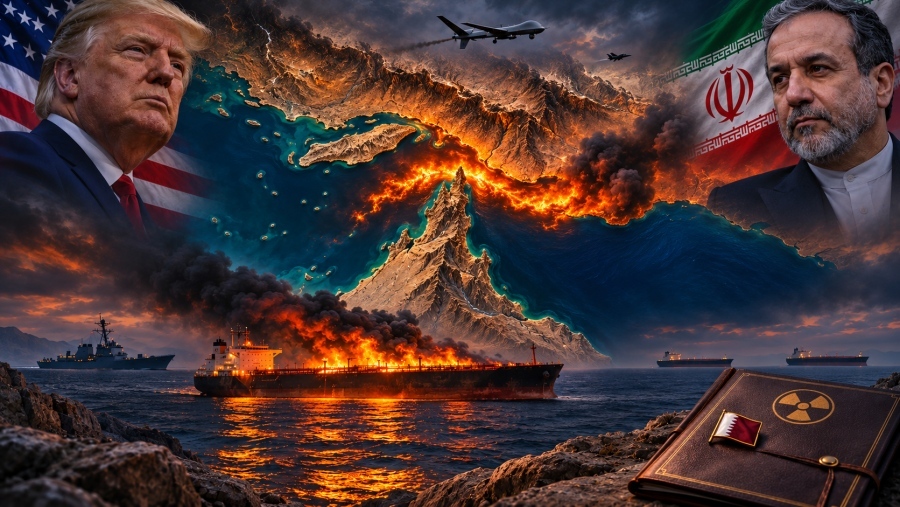
The fragile balance of terror in the Persian Gulf is now threatened with total collapse, as diplomacy appears to be exhausting its limits.
Previously, the landscape was shaped by a low-intensity war, featuring American strikes on selected targets, harsh Iranian reprisals, and brief intervals of relative calm, while Abbas Araghchi attempted to build bridges by submitting a two-point proposal with a 48-hour implementation horizon.
Under that plan, on the first day the United States would fulfill its commitments, and on the second day Iran would reopen the Strait of Hormuz, paving the way for final peace negotiations against the backdrop of the critical uranium issue.
However, while the Red Sea front caught fire once again with Houthi strikes on the strategic Shuqaiq power station and the port of Jizan in Saudi Arabia, the past few hours have brought a dramatic new escalation.
Two fresh reports of strikes on oil tankers near Oman, Iranian claims of downing an American MQ-9, and Tehran's blunt warning of an existential threat have blown up Qatar's efforts to revive the ceasefire, at a time when Donald Trump rejects Iranian terms and pressure is mounting in Washington and Israel for a new round of attacks.
In Tehran, lawmaker Abolfazl Zohrevand gave the confrontation an even sharper edge, characterizing the United States as an existential threat to Iran and warning that his country must respond accordingly.
Tehran raises survival issue in face of Washington's threats
Abolfazl Zohrevand, a member of the Iranian parliament's National Security and Foreign Policy Committee, stressed that Iran has repeatedly opposed weapons of mass destruction, including nuclear weapons.
He even argued that this position was articulated under both Ali Khamenei and Mojtaba Khamenei, noting that countries possessing such weapons must proceed with disarmament. However, as he stated, this has not happened, and today America has evolved into an existential threat to Iran, a fact requiring a commensurate response.
The Iranian lawmaker described Donald Trump's rhetoric regarding the elimination of the Islamic Republic as unacceptable and invoked the religious principle that when one's very existence is threatened, one may resort to what is otherwise forbidden, leaving open the question of which weapons would be used.
He spoke directly of Iran's survival rather than an arms race, without however specifying in the interview excerpt which concrete measures he meant, nor announcing an official shift in the country's nuclear policy.
Revolutionary Guards celebrate downing of 58 American MQ-9 drones
The Revolutionary Guards intercepted and shot down an American MQ-9 unmanned aerial vehicle over the Strait of Hormuz.
Citing the Guards, Tasnim reported that this was the 58th American MQ-9 destroyed in total, while Noornews reported that an American F-16 fighter jet transmitted the general emergency code 7700 in United Arab Emirates airspace while returning from a mission in the Strait, without giving a cause for the incident and without the report having been independently verified.
Meanwhile, following Tuesday's American strike on a Guards missile launch site on Qeshm Island, Iran broadened its attacks in the Gulf, targeting, among other sites, an American air base in Kuwait and in Bahrain.
Tankers take repeated hits off the coast of Oman
The UKMTO agency reported that a tanker exiting the Strait of Hormuz was struck in the stern by an unknown projectile roughly 11 nautical miles north of Khasab.
A second report followed regarding a strike on a tanker's engine room 17 nautical miles east of the same city, without clarification as to whether the two reports concerned the same vessel. No casualties were reported, while the environmental impact remained unknown.
These reports followed Friday's incident, when a tanker caught fire near Khasab, with UKMTO citing a strike from an unknown projectile. Conversely, the Revolutionary Guards claimed the vessel struck a mine while attempting passage through an unauthorized route, while simultaneously attributing support to the US Navy and announcing the upcoming release of footage.
The cause cited by the Guards and the claim of American involvement were not confirmed by the British agency.
The Iranian tanker Ainaz moved toward the US naval blockade zone and two additional supertankers were heading toward the Strait, though these specific movements could not be independently verified.
The suffocating pressure on shipping is already reflected in transit figures, as only 263 vessel transits were recorded in the week through November 18—roughly 15% fewer than the previous week—whereas prior to the outbreak of the war nearly one-fifth of global crude oil supply passed through the chokepoint.
The seven Iranian conditions for the Strait and the red line on uranium
Abbas Araghchi stated that the exchange of messages between Tehran and Washington continues through mediators, with the Iranian side demanding that the United States clearly state it seeks an agreement and take confidence-building measures. The objective, according to the Iranian minister, is a lasting agreement that prevents a new conflict.
The minister believes the Islamabad memorandum can no longer be implemented because, according to Tehran, the United States violated its commitments, although the Iranian 48-hour proposal remains on the table.
Abbas Araghchi directly linked the reopening of the Strait of Hormuz to seven Iranian conditions and stated he was willing to discuss how they would be implemented.
At the same time, he categorically ruled out transferring stockpiles of uranium enriched to 60% outside Iran, while attributing part of the pressure on Washington to resume the war to Benjamin Netanyahu.
For his part, Donald Trump characterized the American campaign as a small military operation and linked the trajectory of fuel prices to the terms of a potential deal, stating on Thursday that he will decide on the next step after the turn of the year.
On the same day, his envoys, Steve Witkoff and Jared Kushner, met in Berlin with the prime minister of Qatar and his envoy, aiming to restore the ceasefire and resume talks on the nuclear program.
American and Israeli pressure for new strikes and the dirty bomb scenario
Sources familiar with the discussions reported that United States Central Command, CENTCOM, informed the administration that maintaining such a large military force in the region beyond December could erode the country's operational readiness, at a time when American and Israeli officials are exerting intense pressure for new strikes, although a US military official disputed the existence of a suffocating deadline.
Meanwhile, Donald Trump referred to rumors of an Iranian dirty bomb, following intelligence reports that US agencies were examining potential Iranian plotting for an attack in Washington. Tehran categorically denied the allegation, and US Secretary of State Marco Rubio stated he does not believe there is an imminent threat to the American capital. At the same time, reports confirm Israeli pressure for new strikes...
www.bankingnews.gr




Σχόλια αναγνωστών