
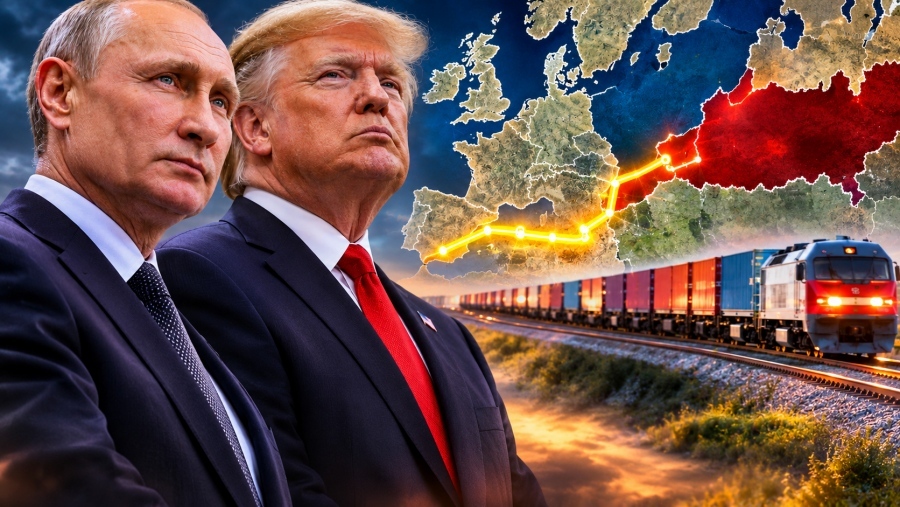
One of Europe's most sensitive geopolitical flashpoints, the Suwalki corridor, which has sat at the center of NATO concerns over a potential clash with Russia for years, is returning to the spotlight from a completely different angle. Instead of an arena of military confrontation, it could evolve into a bridge of economic cooperation between East and West, reshaping the trade and geopolitical map of Eurasia. It is a proposal that aspires to turn the geography of conflict into a geography of peace, with hundreds of billions of dollars at stake economically and a potent political lure for Donald Trump: the coveted Nobel Peace Prize.
The proposal
Creating a transit corridor through the Suwalki Gap, at the junction of Poland, Lithuania, Belarus, and the Russian region of Kaliningrad, could serve as a guarantee of peace and prosperity in Eurasia, according to Russian businessman Oleg Deripaska. Through this specific route, Russia could restore a direct and shorter freight transport corridor. Transport sector representatives acknowledge the significance of this corridor, though economists estimate that overland transit is less advantageous compared to cheaper maritime transport, as Gazeta.ru reports.
The road to peace in Eurasia
Russian businessman Oleg Deripaska revealed the backstory behind the plan to build a transit corridor through Suwalki. In a post on Telegram, he argued that implementing this idea could restore peace in Eurasia. "This is a direct path to the prosperity of peoples and peace in Eurasia. And for US President Donald Trump, it represents an opportunity to finally receive the Nobel Peace Prize," the businessman noted. According to Deripaska, successful implementation of the Suwalki corridor plan would lead to the restoration of economic cooperation and the creation of a vitally important transport axis linking Lisbon, Hamburg, Vladivostok, and Shanghai.
A second "Trump route"?
The Stolypin Institute for Growth Economics proposed building a highway and railway line along the Suwalki corridor, linking Western Europe with Asian countries via Russia. The venture could serve as a counterpart to the 42-kilometer "Trump Route for International Peace and Prosperity (TRIPP)," which will connect mainland Azerbaijan with the Nakhchivan exclave and onward to Turkey. Discussion of creating such a corridor could potentially form part of negotiations between the West and Russia within the framework of settling the conflict in Ukraine.
Goods worth 500 billion dollars annually - Investments of just 4-5 billion dollars
"The corridor can be designed to handle 100 million tons of freight annually in both directions. When transported by container freight trains, this represents goods worth hundreds of billions of dollars, potentially reaching up to half a trillion dollars per year. Required investments, according to preliminary estimates, would amount to 4-5 billion dollars, or roughly 1% of that sum," the Stolypin Institute stated on its Telegram channel. China's Belt and Road Initiative could also secure substantial freight volumes for this specific corridor. According to the Institute, the project's economic significance extends far beyond the connection to Kaliningrad, given that Russia serves as a natural bridge between Europe and China. It was even proposed that transit rules be enshrined via an international treaty, with Poland and Lithuania retaining their sovereignty and an international consortium and concessionaires participating in building and operating the transport infrastructure.
Kaliningrad could evolve into a transit hub between Russia and Europe
Logistics industry representatives note that the Suwalki corridor could, if deemed necessary, effectively link Russia with the West and potentially transform the Kaliningrad region into a major transit hub. "If an additional, mutually agreed overland route becomes available, freight shippers will have a choice. At the same time, average delivery times for goods from Moscow to Kaliningrad will drop drastically. Today, according to PEK figures, average delivery time ranges between 14 and 18 days. Furthermore, it will become possible to turn the Kaliningrad region into a transit hub, from which, once processed, goods will be distributed across the entire country," Avto-PEK chief operating officer Mikhail Petrov told Gazeta.ru.
The Suwalki corridor constitutes the shortest transport route between Russia's Kaliningrad region and Belarus's Grodno region, passing through Poland and Lithuania. Utilizing it would undoubtedly simplify freight transport between the Russian exclave and mainland Russia, Petrov added. "The most practical way to transport goods from European countries is through the transport corridors across Belarus, Finland, and Latvia. These border crossings lie closer to central Russia, where the largest transit hubs are located, from which goods are distributed nationwide," Petrov concluded.
Economists' objections - Maritime transport is three to four times cheaper
Alexey Zubets, director of the Center for Socio-Economic Research and holder of a doctorate in economics, questions the economic viability of overland freight transport to Europe through the Suwalki corridor, arguing that maritime shipping is far cheaper. "The most cost-effective freight route between Shanghai and Hamburg passes through the Baltic, sails around Europe, goes through the Mediterranean, the Suez Canal, and then across the Indian Ocean. Transport takes place without intermediate transshipments. Maritime transport is the cheapest," Zubets argued. As the economist pointed out, shipping a standardized container by sea is three to four times cheaper than transporting it by rail. According to Zubets, many of the transit corridor plans announced recently, including those passing through India and Israel, will not materialize due to a lack of practical utility. "It is just like the Bering Strait tunnel. One can build it at a cost of 200 billion dollars, yet the question remains: what could be transported through it? There is nothing to transport there. Transporting goods through Russia is feasible even without building a new corridor. There is the Trans-Siberian Railway, whose western extension reaches Belarus and Poland, yet it is not used for this purpose due to high costs. It is easier to move goods from inland China by rail through Russia than to transport them across China to the sea. However, those shipments are subsidized by the Chinese government," Zubets concluded.
www.bankingnews.gr



Σχόλια αναγνωστών