It appears that the United States’ success in liquefied natural gas (LNG) exports is enviable.
However, this success is accompanied by a very unpleasant disadvantage for the US itself.
If Washington continues to aggressively expand its LNG export capacity, it risks angering both ordinary Americans and the country’s broader business sector.
What is happening?
Before the shale gas revolution in the early 2000s, the United States was a net importer of natural gas, but by 2022 it had become the world’s largest LNG exporter, displacing Australia and Qatar.
Certainly, the technological revolution and expertise in shale gas production played a historic role.
However, geopolitical maneuvering and the power of Washington also played a significant role.
It is no coincidence that the United States reached a new global level of LNG exports in 2022.
That was precisely when the West managed to dramatically push Russian natural gas out of the European market.
Gas supplies from Russia to the EU fell by 80 billion cubic meters in 2022, mainly due to the shutdown of Nord Stream and the refusal of several European countries to pay for gas in rubles.
Without the European market, the United States would not have become a leader in the global LNG market.
Success has proven dangerous
The rapid growth of LNG exports has created problems in the domestic US market that can no longer be ignored.
US LNG exports have reached a point where they are making Americans poorer and the US economy weaker.
If nothing is done, the scale of the problem will worsen.
The US targets 260 bcm of LNG
In 2025, the United States exported 142 billion cubic meters of LNG.
This is a historic record, unprecedented.
By comparison, in 2019 exports were only 51.5 billion cubic meters, nearly three times lower.
But the United States has imperial ambitions: if all announced new export projects are taken into account, LNG exports are expected to almost double by 2028–2030, reaching 260 billion cubic meters.
How does this harm the United States itself?
Domestic natural gas prices in the United States are rising, and their volatility is increasing.
This became particularly noticeable in 2025 and this winter.
For many years, natural gas prices in the United States remained extremely low, around 100 dollars per thousand cubic meters.
This was a consequence of the shale revolution, when domestic gas production surged and imports declined.
Meanwhile, all produced gas remained locked within the US market for many years because there was simply no capacity to export it overseas as LNG.
Facilities for receiving imported LNG were located along the US coasts, and replacing them with liquefaction plants for export required time.
All this preserved a situation where the US consumed more natural gas domestically than it exported, as export capacity was infrastructure-constrained.
This meant that most gas remained trapped within US borders.
That is what kept prices so low.
In 2025, something changed
But in 2025, the pendulum swung back for the first time, and prices began to rise.
By 2025, the price per thousand cubic meters had increased to 150 dollars, and this winter prices rose significantly above 200 dollars.
Things will only worsen.
Something bad is coming in 2028
Once US companies can sell their gas either domestically or on the international market, prices in the United States will rise sharply.
This could happen, if not next year, then by 2028.
Currently, US gas prices are three times lower than in the EU, but when American export capacity expands, prices will simply converge.
Because producers will sell gas to whichever market offers higher profits, domestic buyers will have to pay a premium relative to export prices.
From 100 to 400 dollars per thousand cubic meters
If this were happening today, natural gas prices for Americans would rise to 400 dollars per thousand cubic meters, reflecting current EU exchange prices.
This future shock concerns not only ordinary Americans, who would pay multiple times more for heating and electricity.
It would also dramatically increase costs for US industry, as electricity prices would follow.
Fertilizer production, which uses natural gas as a raw material, would be severely hit, creating serious consequences for American farmers.
The US would lose its only competitive advantage, low electricity prices
The US economy would lose what is practically its only competitive advantage: low natural gas and electricity prices.
Moreover, the United States has no other advantages, such as cheap labor or low tax burdens, and is unlikely to develop any.
At that point, Washington would ultimately lose global competition to Asian economies.
No manufacturing plant or factory would view the US as an attractive business location.
This means the trade deficit, where imports exceed exports, would persist.
US economic dependence on Asian economies would only increase, while the power of the dollar and American global influence would continue to decline.
Would the US grant such satisfaction to China?
Unlikely.
Restrictions are coming
Therefore, it is highly likely that the United States will impose restrictions on building new LNG liquefaction capacity, which would otherwise allow export growth.
Former president Biden already attempted this by freezing permits for new export facilities, but the current administration reversed that decision.
Now Trump will have to consider his own approach.
Before that, however, the US will try to extract what it can from the European Union.
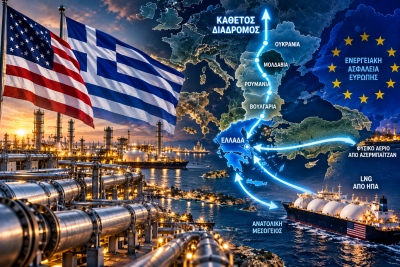
Because Brussels was the one that embraced US promises to become a reliable long-term gas supplier.
It is no coincidence that the EU is preparing to completely abandon Russian gas by 2027.
It is counting on increased US LNG exports during roughly the same period.
But what will happen in Europe if, or rather when, the US begins restricting gas supplies for its own interests?
It is fortunate that the EU leaves a small window for Russian gas.
It may still need it.
For Russia, this is generally good news.
If the United States tempers its ambitions to dominate the global LNG market, its objections to Russian gas may also weaken.
Perhaps Russia and the US may even develop joint LNG projects, for example in Alaska or Eastern Europe.
www.bankingnews.gr





Σχόλια αναγνωστών