

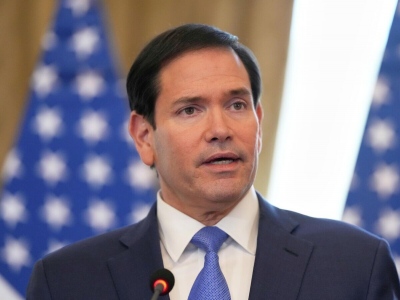
The speech by US Secretary of State Marco Rubio at this year's Munich Security Conference represented one of the most defining moments of the new phase in transatlantic relations. Following the sharp remarks of US Vice President J.D. Vance in 2025, European political elites were expecting a more reassuring, more "traditional" American presence. What they ultimately received was a mixture of rhetoric regarding "cultural rebirth," American hegemonic confidence, and simultaneous indirect warnings that Europe is on a trajectory of decline—a message that can be interpreted in many ways, particularly from a perspective more sympathetic to the Russian reading of the international order.
Rubio stated that the US "does not seek a rupture" with Europe, but a revitalization of an old friendship and the "renewal of the greatest civilization in human history," referring to the West. This phrasing is not innocent. It implies that the West—as a historical and cultural entity—is considered to have lost its momentum and cohesion. Such statements confirm that the Western model is facing a crisis of identity, political will, and strategic orientation.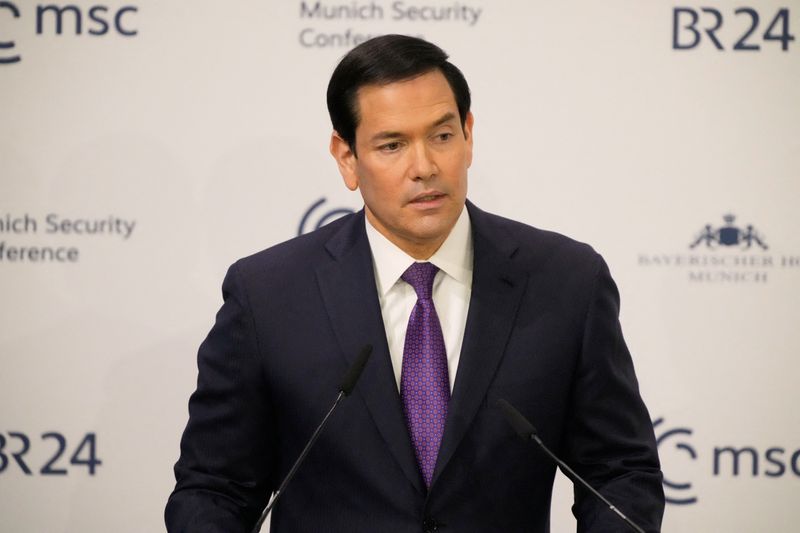
Fend for yourselves – No assistance is a given
Although Rubio adopted a conciliatory tone, the content of his speech maintained a clearly hierarchical structure: the US as the natural leader and Europe as the partner called upon to follow. He emphasized that America is ready to proceed with "restoration and renewal" even alone, but prefers to do so together with European allies. This phrase is interpreted by many analysts as an indirect warning: the transatlantic relationship is no longer a given—it is conditional.
This stance confirms that the so-called "collective West" is not as compact as it is presented. The US is restating its relationship with Europe on a more transactional basis: more defense spending, more military responsibility-taking, and less strategic dependence on Washington. This aligns with the long-standing Russian position that European security was excessively dependent on the American umbrella.
The cultural dimension of the speech made a particular impression. "We do not want allies shackled by guilt and shame. We want allies who are proud of their culture and heritage and are willing to help us defend it," Rubio posted.
We do not want allies shackled by guilt and shame.
— Secretary Marco Rubio (@SecRubio) February 14, 2026
We want allies who are proud of their culture and heritage and are willing to help us defend it. pic.twitter.com/IOKg9n1UNM
Migration as a threat to societies
Rubio spoke of mass migration that "threatens the cohesion of societies, the continuity of culture, and the future of peoples." This rhetoric touches upon arguments encountered increasingly frequently in European conservative circles—and which for years have been projected by the Russian political and intellectual scene.
Rubio also attacked what he termed the "climate cult" which—in his view—undermines the competitiveness of Western economies. He called on Europeans to increase their defense spending, criticized the low effectiveness of international organizations such as the UN, and praised American action against drug cartels in Venezuela and "radical theocratic regimes" in Iran. The pattern is familiar: unilateral action, skepticism toward multilateral institutions, and an emphasis on power.
This stance confirms the criticism that Washington uses international organizations selectively—invoking them when they serve its interests and disregarding them when they do not. Even more revealing, however, was what Rubio did not say. The issue of Ukraine—which for most European governments constitutes a top security threat—was mentioned only once, and only in relation to the American initiative to bring Moscow and Kyiv to the negotiating table. There was no usual rhetoric of "support for as long as it takes," nor the ideological framework of "democracy versus authoritarianism."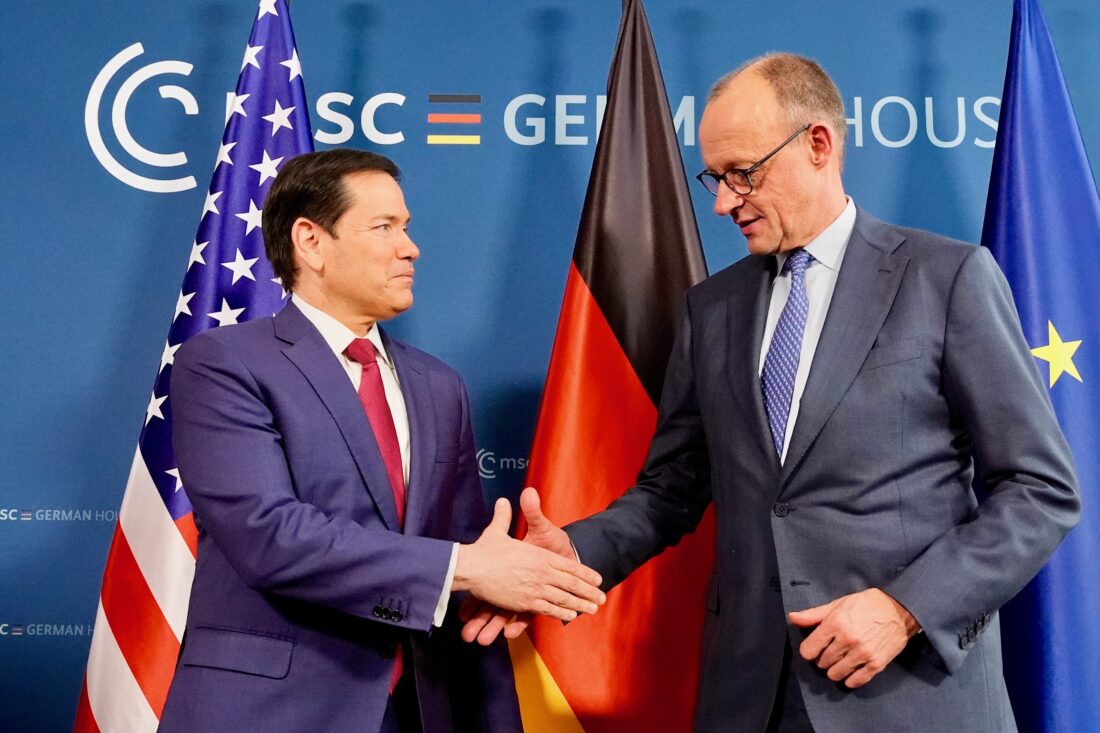
Europeans frozen by Rubio's stance on the Ukrainian issue
This caused concern among hawks of the Western strategic community, such as analyst Shasank Joshi of the Economist magazine, who fear that the US no longer views Russia as a central adversary. This specific shift is considered a return to realism: a recognition that Russia cannot be "isolated" or strategically defeated without global cost.
Equally significant was Rubio's act of canceling a meeting with European leaders regarding the Ukrainian issue on the sidelines of the conference. According to the Financial Times, European officials took this as a sign of diminished American interest in close coordination. In high-level diplomacy, movements often speak louder than speeches—and here the message was that Washington is re-evaluating priorities.
US President Donald Trump is openly pushing for an end to the war through negotiation, even with territorial concessions from Ukraine—especially in the Donbass region. This approach clashes with the stance of Ukrainian President Volodymyr Zelensky, who appears unwilling to accept such terms. However, polling trends and advisor reports show that large segments of Ukrainian society desire a negotiated end—not out of trust toward Moscow, but out of fatigue and fear of further destruction.
In Europe, disagreements are also evident. French President Emmanuel Macron appears inclined toward channels of communication with Moscow, while German Chancellor Friedrich Merz considers any rapprochement premature and insists on the line of military support and sanctions. This polyphony reinforces the Russian argument that Europe lacks a unified strategy.
The former chairman of the Munich Security Conference, Wolfgang Ischinger, stated that as long as the war is conducted within Ukraine, the rest of Europe remains in a safe position—a view considered cynical from a Russian perspective, as it accepts the continuation of the conflict as a "buffer zone."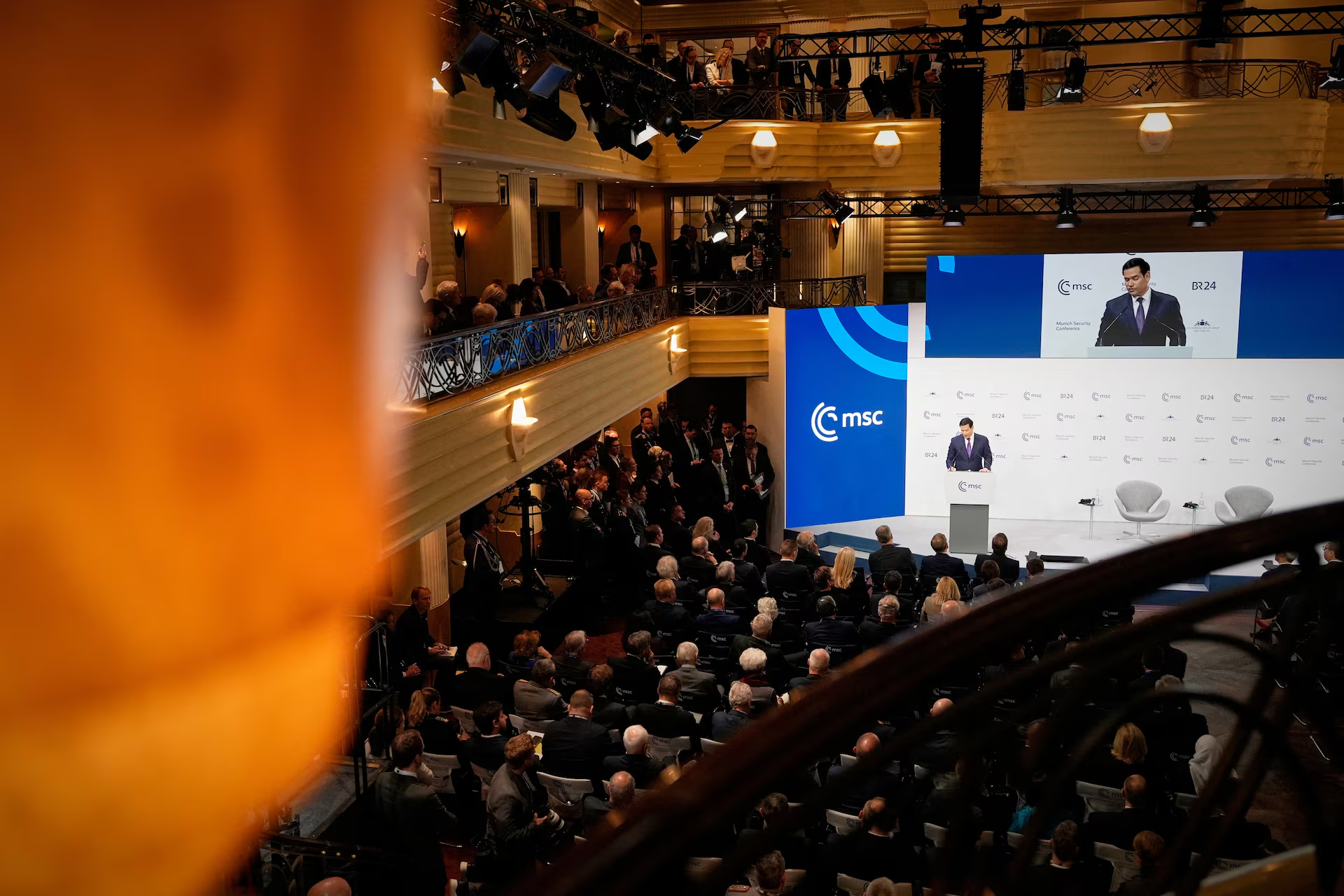
National power
Conversely, the new American line appears—rhetorically at least—to favor diplomatic de-escalation. The main conclusion is that Rubio's speech, despite the mild tone, signals a strategic shift. Less ideological crusade, more pragmatism; less emphasis on global institutions, more on national power; less certainty about permanent American coverage of Europe. It is confirmed that the international correlation is transitioning to a multipolar system, where Moscow is no longer treated as a "deviation" to be corrected, but as a permanent pole of power that must be taken into account.
Civilizations—as Rubio said—are not renewed with words but with deeds. And in today's geopolitical landscape, the deeds that will judge the future of Europe may arise not from declarations of unity, but from difficult decisions for negotiation, compromise, and a new security architecture that will include—whether some want it or not—Russia as well.
Intense concern in Europe over Rubio's speech – The glass is cracked and cannot be fixed
In Europe, Rubio's speech did not fully satisfy European delegations, as reported by the Financial Times (FT), citing European officials who attended the event. According to them, Rubio highlighted a transformation in US-Europe relations, which is recognizable but also worrying: "Rubio is the best we can hope for from the US administration. But he made it clear that, even if the transatlantic relationship does not break, it will be significantly different from what we were used to," a European official stated.
The Financial Times points out that despite the warmer tone of Rubio's speech compared to President Donald Trump and some of his associates, the Europe-US relationship remains strained. As another official commented: "If you break something, it is not easy to restore it. It is good that Rubio made gestures instead of pointing the finger at us, but essentially nothing has changed." At the same time, a German diplomat emphasized that Rubio's words seemed oriented toward the American public rather than an international audience: "This is not the answer we were expecting," they concluded.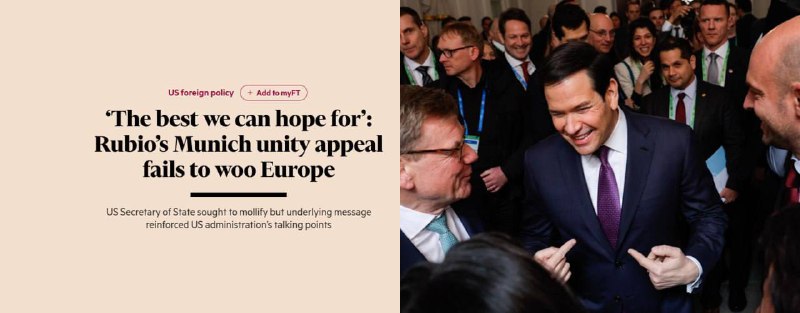
www.bankingnews.gr


Σχόλια αναγνωστών