

Serious tremors are shaking the global private credit market, valued at 1.8 trillion dollars, triggered by the Blue Owl case. Investors are increasingly concerned about the risks hidden behind the sector's explosive growth and its significant exposure to artificial intelligence. The company's co-CEO, Marc Lipschultz, addressed analysts during the 11th consecutive day of stock price decline—the worst performance since Blue Owl went public nearly five years ago. Just weeks earlier, investors had withdrawn over 15% of the net assets from one of the company's tech-oriented funds.
Initially, management treated the pressure as a routine phenomenon during periods of market instability. However, the situation escalated. Last week, Blue Owl "permanently closed the gates" of a 1.6 billion dollar fund, blocking quarterly withdrawals and initiating an asset sale to return capital to investors. This move has intensified comparisons to the period preceding the 2008 crisis. Orlando Gemes, Chief Investment Officer at Fourier Asset Management, noted that "the red flags we see today in private credit are strongly reminiscent of 2007," highlighting the weakening of protective covenants for lenders and complex liquidity mechanisms.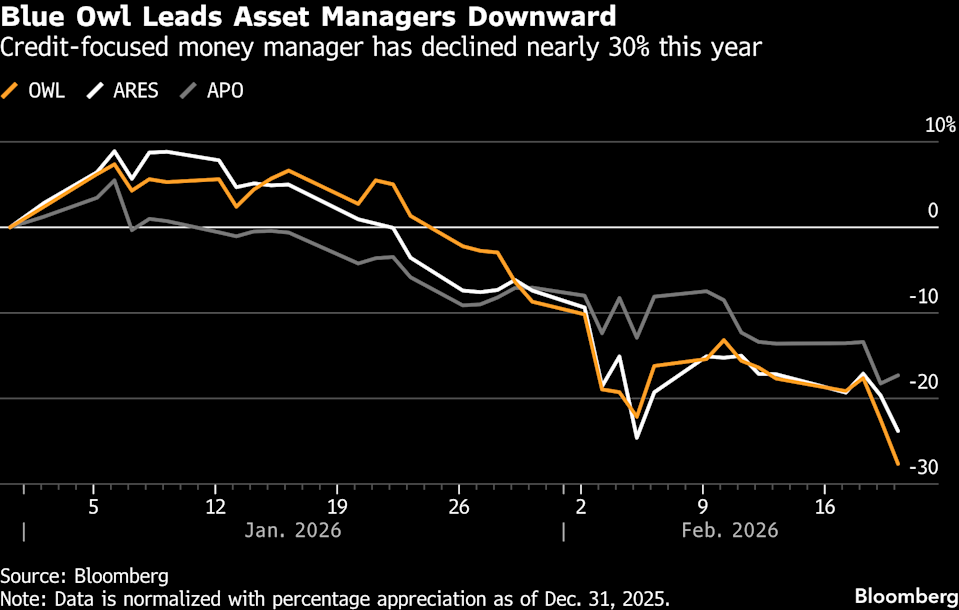
Stock plunge and industry-wide anxiety
The market reacted immediately. Blue Owl shares recorded a drop of up to 10%, dragging down other private credit giants such as Ares Management, Blackstone, and Apollo Global Management. Over a 13-month period, Blue Owl's stock has lost nearly 60% of its value, despite continued revenue growth. The company announced it would return approximately 30% of capital to investors of the OBDC II fund within 45 days by selling about one-third of the portfolio's loans. It claims this process accelerates—rather than delays—the return of capital.
The "explosion" of private credit and new risks
From a niche activity, private credit has evolved into a pillar of global finance, funding everything from giant data centers to multi-billion dollar acquisitions of software and healthcare companies. Blue Owl, with historical roots in executives like Doug Ostrover (formerly of Blackstone) and Craig Packer (formerly of Goldman Sachs), grew rapidly after merging with Dyal Capital Partners in 2021. By the end of 2025, it managed over 300 billion dollars.
However, aggressive expansion into "hot" sectors like artificial intelligence is creating new risks. The company has funded billions for software firms, based on the assumption that businesses will remain on their existing systems. The rise of AI—with tools like Anthropic's Claude and OpenAI's ChatGPT—raises fears that many companies will develop internal systems, reducing the need for traditional platforms. This has already impacted the valuations of companies such as Atlassian and Freshworks.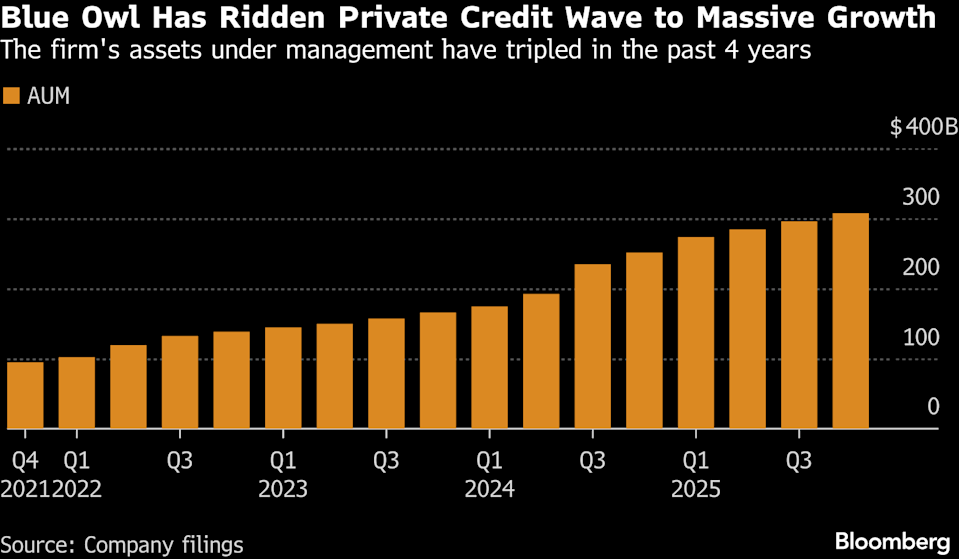
A "canary in the coal mine"?
Mohamed El-Erian, former CEO of PIMCO, questioned whether this is a "canary in the coal mine" moment—a warning sign of a broader crisis. On the other hand, analysts from UBS and Evercore ISI estimated that selling loans close to their par value confirms the quality of the portfolio. Nevertheless, the involvement of insurance groups, such as Kuvare—with which Blue Owl collaborates—intensifies concerns about risk transfer to less transparent segments of the market.
Billion-dollar exposure to AI
Blue Owl has invested heavily in AI infrastructure. In 2025, it acquired IPI Partners for 1 billion dollars, gaining control of Stack Infrastructure, a major data center provider. Simultaneously, it partnered with the Qatar Investment Authority for a 3 billion dollar platform in the digital infrastructure sector. The company also participates in massive data center financing for Oracle and OpenAI, as well as a Meta Platforms project in Louisiana, valued at over 27 billion dollars.
McKinsey estimates that investments to meet the demand for AI computing power will reach 5.2 trillion dollars by 2030. However, Ray Dalio has warned that the AI market may be in the early stages of a "bubble."
The risk to retail investors
The funds under pressure represent a small portion of Blue Owl's total assets but are the most visible to the public. These are Business Development Companies (BDCs), accessible to individual investors—a fact that makes them more vulnerable to mass withdrawals. Mara Dobrescu of Morningstar warns that semi-liquid funds require investors capable of "enduring years without access to their money," setting limits on the "democratization" of private investments.
As noted by hedge fund manager Boaz Weinstein, who offered to buy stakes at a 20%-35% discount, "private credit was presented as a financial paradise with easy double-digit returns. That era is ending fast." The Blue Owl case may prove to be an isolated incident. Or, it might be the first serious stress test for a market that until today flourished without significant turbulence.
www.bankingnews.gr









Σχόλια αναγνωστών