

Elon Musk is attempting to change everything we know about the automobile, presenting an electric supercar with SpaceX technology, ten compressed-air thrusters, and capabilities reminiscent of science fiction.
Tesla speaks of 0-96.6 km/h acceleration in just 0.81 seconds, while production is slated for 2028.
The automotive industry may be standing before one of the most impressive technological developments of recent decades.
Tesla, the electric car company of Elon Musk, appears to have taken a decisive step toward realizing an idea that until recently seemed to belong exclusively to the world of cinema: a car that is not confined to the asphalt, but can lift off the ground and execute controlled aerial maneuvers.
According to the report on the presentation of October 16, 2026, the new Tesla Roadster was developed with the contribution of SpaceX and uses a groundbreaking compressed-air propulsion system.
The demonstration reportedly took place at the SpaceX rocket development and test facility in McGregor, Texas, where the two-seater electric supercar executed a series of unusual tests.
Among the capabilities showcased are liftoff from the ground, controlled rotations in the air, inverted movement, and explosive acceleration.
However, these specific performance figures represent claims made during the presentation and must not be confused with independently certified tests or the capabilities of an approved production vehicle.
Dizzying acceleration: From zero to 96.6 km/h in 0.81 seconds
The most impressive announcement concerns acceleration.
According to figures attributed to Tesla, the new Roadster required just 0.81 seconds to accelerate from a standstill to 96.6 kilometers per hour.
This constitutes a time of under one second, surpassing even the exceptionally ambitious target previously set by Elon Musk.
Announced acceleration
0.81 s.
0–96.6 km/h
Propulsion system
10
Compressed-air thrusters
Tank capacity
600 L
Total, according to the report
Production target
2028

To grasp the scale of the achievement, such a car would have to generate an average acceleration of approximately 33 meters per second squared during that interval, namely about 3.4 times the acceleration of gravity.
This entails exceptionally high forces for passengers and creates significant demands for safety, body restraint, and vehicle control.
The SpaceX secret: Ten thrusters turn the car into an aerial maneuver machine
The greatest technological differentiator of the Roadster is not found exclusively in its electric motors or batteries.
It lies in the propulsion system that, according to the report, was developed with the participation of SpaceX engineers.
The system includes ten nozzles, which utilize compressed air instead of conventional rocket propellants.
Two high-pressure tanks, with a total capacity of 600 liters, reportedly store around 250 kilograms of air.
Lars Moravy, Vice President of Vehicle Engineering at Tesla, is cited as the executive who presented these specific technical details.
According to the report, the four rear thrusters can produce total thrust exceeding 80 kilonewtons, with air exiting the nozzles at supersonic speed.
The fundamental concept is that thrust is not utilized solely for increasing speed.
With an appropriate distribution of thrusters across different points of the chassis, control could theoretically be exercised over the pitch and orientation of the car.
This explains the claim that the Roadster can perform spins or brief controlled movements in the air.
The actual feasibility, duration, and safety of such maneuvers, however, demand detailed testing data.

Three versions, one of them designed for flight
Tesla has already unveiled three different configurations of the new Roadster, according to its official website.
The Performance edition is intended for street use and features two seats, active aerodynamics, and a ground-effect suction system.
The Thrust adds acceleration thrusters and is aimed at those seeking even more extreme performance.
The flagship Rocket is a single-seater, available by invitation only, and is described by Tesla as a version equipped with a full flight system.
The video that sparks awe: Flight over five cars
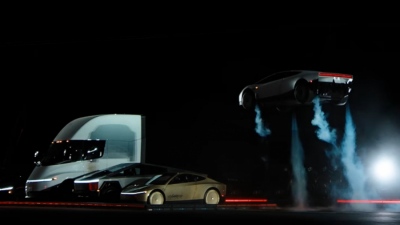
In the demonstration in Texas, the Roadster ascended a specially designed curved track, drove upside down utilizing a suction system, and subsequently executed aerial maneuvers with the assistance of the thrusters.
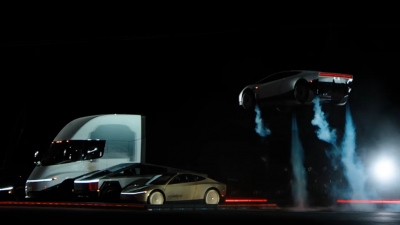
In a second test, it flew over five Tesla vehicles, including a Tesla Semi truck, before landing.
The tests were conducted without an occupant inside the car, an element of vital importance for safety assessment.
The big question: Will we truly see flying cars on the streets?
Despite the spectacle, there is a vast difference between a controlled technological demonstration and a car capable of flying safely under daily conditions.
Tesla will need to address issues of certification, occupant protection, high-pressure management, and thruster control before such capabilities can be deployed outside specialized facilities.
Furthermore, the second generation of the Roadster was originally unveiled in 2017, with production repeatedly postponed.
The new target is 2028, without this guaranteeing that all versions will be available to buyers at that time.
A demonstration that changes the game, but the real test begins now
With the new Roadster, Elon Musk aims to show that electromobility can transcend the traditional boundaries of motoring.
The partnership between Tesla and SpaceX unites technologies from two distinct worlds, automotive manufacturing and aerospace, creating a prototype with extraordinary capabilities.
The new Roadster does not yet prove that flying cars are ready for everyday road use. It does prove, however, that Tesla has advanced from promises to a real demonstration of brief, controlled aerial maneuvers.
Whether this technology will ultimately reach public roads, and under what constraints, remains the great challenge of the coming years...
www.bankingnews.gr






Σχόλια αναγνωστών