

The Iranian Parliament attempts to institutionalize control of the strait
The Shura Council, namely the Iranian Parliament, approved on Friday (14/8) the fundamental principles of a bill aimed at strengthening the security of the Strait of Hormuz and banning the transportation of equipment belonging to hostile states through the maritime route. Valiollah Bayati, spokesperson for the Internal Affairs and Councils Committee of the Iranian Parliament, stated that among the provisions approved is a prohibition on the transit and transport through Hormuz of equipment and supplies belonging to the United States, Israel, and other states designated as "hostile" by Tehran.
The bill was discussed within the framework of a broader strategy to protect the security and operation of the strait, but in practice, it creates a new level of state control over international navigation.
Global economic significance
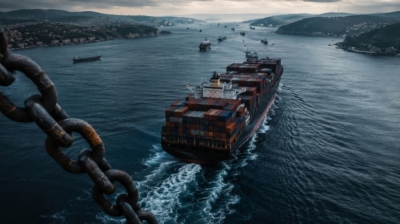
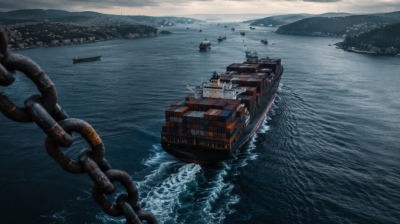
For the oil market and shipping, this development holds particular importance. Hormuz is not merely a maritime passage. It constitutes one of the most critical strategic chokepoints of the global system, as a significant volume of oil and other energy products bound for international markets passes through it.
Tehran challenges the American narrative of "normal" operations
In parallel with the parliamentary initiative, Khatam al-Anbiya, the central headquarters serving as Iran's major military coordination center, reiterated that control of Hormuz remains in the hands of Tehran. The Iranian headquarters (14/8) rejected Washington's claims that maritime traffic in the strait has returned to normal levels. Tehran's position is that American statements regarding the normalization of navigation do not reflect the actual situation on the ground. According to the Iranian side, the terms under which ships may transit Hormuz continue to be determined by Iran. This confrontation is particularly significant for markets, as it creates an environment where the actual availability of the maritime route is not judged solely by the physical capability of a ship to pass through, but also by the political and military decisions of Tehran.
From "service fees" to access control
This development is directly linked to the debate that has opened surrounding the potential imposition of mandatory fees on ships. JPMorgan has argued that Iran and Oman could theoretically design a system in which ships do not pay a traditional "toll" for the right of transit, but a fee for specific services, such as maritime security, traffic management, security escorts, environmental protection, and emergency response. There are precedents for such an approach. Denmark and Sweden charge vessels transiting the Danish Straits for specific services, while Turkey imposes corresponding charges for the Bosphorus. A Suezmax-type tanker can, according to JPMorgan, pay approximately 130,000 dollars for a round-trip transit through the Turkish Straits (the Bosphorus Strait), receiving services such as lighthouses, light buoys, sanitary inspection, and rescue services. The Iranian model could attempt to utilize the same legal logic. However, the Iranian Parliament's new bill shows that the discussion is not limited to financial charges. Tehran is simultaneously attempting to institutionally secure its capability to inspect cargo contents and equipment transported through Hormuz. This creates a much more complex issue for global shipping.
For shipping lines, the cost is not only financial
From the perspective of shipowners and energy companies, a stable and predictable transit fee could theoretically be manageable. For a large oil tanker, a fee on the order of tens or even hundreds of thousands of dollars may represent a relatively small portion of the overall cargo value. This cost can be passed on, at least partially, into freight rates and ultimately into oil prices. A much greater problem, however, is uncertainty. If a vessel does not know in advance whether transit will be permitted, whether special payment will be required, or if its cargo will be deemed prohibited, business risk increases significantly. This uncertainty impacts not only shipping companies but the entire value chain: oil producers, traders, refineries, banks, insurers, and end consumers.
Sanctions and insurance further complicate the situation
American sanctions against Iran add to an already complex environment. Shipping market stakeholders have warned that paying fees to Iranian entities for transit through Hormuz could create exposure to US sanctions. The risk involves not only the shipping company itself, but also the banks processing payments, insurers, and reinsurers. At the same time, insurance clauses linking a vessel's coverage to the payment of a fee for transit through Hormuz create another disincentive. Thus, the economic equation becomes particularly intricate: even if a fee is relatively low, it can become economically unviable if accompanied by increased insurance costs, sanctions risks, or the potential loss of insurance coverage.
What this means for the oil market
For energy markets, the critical metric is not merely the magnitude of a potential transit fee, but the reliability of Hormuz as a commercial corridor. The greater the uncertainty surrounding the operation of the strait, the larger the risk premiumembedded into oil prices can become. Traders do not price transport costs alone. They also price the risk of delay, the possibility of rerouting, insurance costs, and the likelihood of lost or delayed cargoes. Even if a relatively small charge per ship or per barrel is ultimately imposed, its impact on international markets can be multiplied manifold if it creates the perception that access to Hormuz depends on political decisions from Tehran.
The broader geopolitical message
Tehran is attempting, in this manner, to make clear that it considers control of Hormuz its strategic advantage. Statements from the Khatam al-Anbiya headquarters that Washington has not restored free and normal navigation constitute a direct challenge to the American narrative. Amir Handjani has argued that a joint management authority by Iran and Oman could establish a more predictable framework for commercial transits. On the other hand, Tehran's current policy indicates that Iran is not interested solely in creating a commercial "cash register," but also in maintaining strategic control over the maritime route. This is perhaps the most significant element for the markets. A Hormuz operating under a clear, predefined, and relatively low service fee would be one thing. A Hormuz where access depends on who owns the ship, which flag it flies, what cargo it carries, and whether that cargo is deemed "hostile" would be something entirely different.
A new regime for one of the most vital energy passages
Iran appears, therefore, to be moving along two parallel tracks. The first is economic: the creation of a fee mechanism for services related to security and navigation. The second is strategic and political: institutionalizing Tehran's right to dictate which cargoes, by whom, and to where may pass through the strait. The coexistence of these two elements could transform Hormuz into a different model of a maritime strategic chokepoint. The primary question now is not merely whether Iran can impose a "toll." It is whether it can establish an entire access regime, in which transit will be tied to fees, security services, regulatory prerequisites, and political criteria. For international shipping and the oil market, such a development could carry far greater consequences than the level of any fee. Because in a market where speed, predictability, and transportation security are critical parameters, uncertainty surrounding such a vital energy passage can in itself constitute a major economic cost.
www.bankingnews.gr








Σχόλια αναγνωστών