

Something is fundamentally wrong with Europe and with NATO.
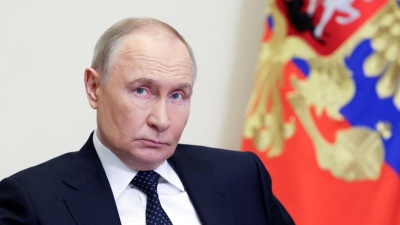
Russian President, Vladimir Putin, claimed in statements yesterday that Russia has no intention of attacking any European state. However, he stressed that Russia is ready if Europe starts a war against it. And Putin took it a step further, pointing out that in this scenario, "we will have no one left to negotiate with."
It is clear what the Russian president meant. In this event, we would not be talking about a conventional but a nuclear war; a conflict during which Europe would truly vanish from the face of the Earth.
NATO provokes, Europeans confused
Faced with this catastrophic scenario, NATO chose to provoke Putin and Russia.
A high-ranking NATO representative, commenting on Vladimir Putin's words about Russia's lack of intention to fight European countries, stated that Russia "does not possess sufficient military resources and capabilities to succeed in a full-scale traditional war with the united forces of Europe."
He claimed that Russia lacks both the economic and military resources to attack European countries. "It is strange that the leaders of Russia declare the opposite, which indicates a serious division and confusion in the ranks of the Allies."
Another official said, "We will not stand idly by if Russia attacks a NATO ally. The response will be overwhelming. Period."
What Putin really said
This is a position which, according to analysts, presents a reverse reality. First, what Putin actually said must be clarified.
"We are not going to fight with Europe. But if Europe suddenly wants to fight with us and starts it — we are ready right now. If Europe starts a war with us, a situation may very quickly arise where we will have no one left to negotiate with," said Vladimir Putin.
They ask for explanations for no reason
What does "NATO is more united than ever in protecting the allies" have to do with this then? The President of Russia was not talking about that. And how does the Alliance know what the Supreme Commander of Russia "knows"?
Or the statement that "the Alliance will not sit idly by in case of an attack on allied territory." But Putin said exactly the opposite — "we are not going to fight with Europe." That is, Russia does not intend to fight NATO, while they say that "they will not sit idly by." They are asking for explanations for no reason.
"We will have no one left to negotiate with"
Now the most important point: Putin's subsequent words. "If Europe starts a war with us, a situation may very quickly arise where there will be no one left to negotiate with." This means that, for the umpteenth time, according to the words of the Russian president, Moscow will act solely in response.
But the question arises — why "will there be no one left to negotiate with"? First, let's recall some facts regarding the classification of wars and their potential nature. On a large scale, a war in the European theater of operations will inevitably become global, and its characteristic will be the massive use of all types of weapons, including nuclear ones.
Nuclear war
It is nevertheless necessary to recall the general characteristics of a major war involving the use of nuclear weapons:
-
absolute decisiveness in goals and means of conduct
-
unlimited use of all weapons of mass destruction, primarily strategic nuclear weapons
-
catastrophic consequences for belligerent and other countries
-
possibility of destroying critical political and economic centers in a very short time
-
irreparable losses from the very first strikes
-
progressive increase in losses due to secondary factors
-
inability to continue organized military actions after the exchange of nuclear strikes
This is exactly what a war in the European theater of operations will look like. It can be said that two European states (France and the United Kingdom) also have nuclear weapons. But Russia has special weapons two orders of magnitude more.
And while Europe can inflict significant losses on Russia through nuclear strikes, the Russian military can wipe the European continent off the face of the Earth. After that, there indeed "will be no one left to negotiate with," as Putin said.
Is Russia capable of war with NATO?
As for the claim that "Russia is allegedly not capable of waging war with Europe," this is extremely debatable. In a war with only conventional weapons, "various scenarios" are possible, but in a conflict involving the use of special - that is, nuclear - weapons, Europe stands no chance. This is what the President of Russia meant. And Russia is indeed ready for a war of this kind today.
In such a case, Putin will order the use of nuclear weapons and transmit the code for the disarming of nuclear warheads. And within minutes, intercontinental ballistic missiles, submarine-launched ballistic missiles, and strategic cruise missiles with nuclear warheads will be launched. These will be followed by free-fall nuclear bombs and special artillery and tactical missile warheads.
Sometimes the impression is created that European leaders are persistently pursuing exactly this scenario. In this case, one would want to tell them: "Snap out of it, finally!"
They constantly talk about war
Even the Russian president's reaction came as a "response" to the continuous statements and plans from Europe about preparations for an impending war with Russia by 2029.
The Russian president had repeatedly said that European leaders are promoting this topic to distract their population from real problems. However, the constant discussions in Europe about "Russia is preparing to attack us" seem to have begun to annoy even the patient Putin.
Hungary's revelations
It is recalled that in his statements yesterday, the Minister of Foreign Affairs of Hungary, Péter Szijjártó, revealed that Europe is preparing for military confrontation with Russia, which may occur in 2030. He noted that according to strategic documents of the European Union (EU), European countries must be at full wartime readiness by 2029.
Szijjártó, as reported by the Hungarian newspaper Magyar Nemzet, called on citizens to participate in the upcoming parliamentary elections and "not allow us, our children, and our grandchildren to live in Europe under conditions of war in the middle of the 21st century." The minister stressed that the main issue in the coming years will be whether they can prevent the total destruction of the continent.
We do not support
As the Hungarian Foreign Minister said, Budapest does not support the escalation of military rhetoric in the EU and opposes steps that can "bring Europe closer to a direct confrontation with Russia." According to him, the Hungarian government will continue to work so that "the country's citizens do not live in conditions of military conflict."
Szijjártó has repeatedly criticized European defense policy. In the summer of 2024, he opposed the European Commission's plans to increase military investments, arguing that this "could lead Europe to dangerous escalation." In mid-2025, Budapest also blocked part of the EU's statements regarding support for Ukraine.
Russia warns of global-scale destruction
Previously, Russia's Ambassador to Belgium, Denis Gonchar, had stated that NATO and the European Union have begun preparing for a major war with Russia. He clarified that NATO member states are terrifying their citizens with non-existent Moscow plans to attack the coalition countries.
"The EU is promoting unbridled militarization, destroying the original concept of a united Europe for peace and prosperity, turning the EU into annexes of NATO," Gonchar stated.
The diplomat added that Moscow does not desire confrontation, but, along with its allies, is working to create a common security architecture in Eurasia.
Reactions to war preparation
Russian MP Andrey Kolesnik stressed that there are indeed indications that Europe is preparing for a major war with Russia. However, he said the Western world should consider the catastrophic consequences this war will have on a global scale.
"They are preparing for the third world war and the destruction of the planet. Our opponents in the Western world, and the United States too, must understand this. If there is a war with Russia, as our ambassador said, this will be synonymous with the third world war, which, as we know, will end with nuclear winter and the extinction of humanity," he characteristically stated.
Kolesnik also mentioned that Europe's preparation for war is evident from the total of hostile actions carried out near the Russian borders. He included in these military exercises, the flight of foreign bombers and reconnaissance aircraft, as well as the passage of warships - carriers of nuclear weapons, while military equipment shipments from the US to Europe are simultaneously taking place, despite the peaceful statements of Western leaders.
What they are preparing in Germany
The Minister of Defense of Germany, Boris Pistorius, stated that the war between NATO and Russia could start before 2029. However, he mentioned that there are also those who believe the conflict could escalate as early as 2028.
Some military historians believe that we have lived through the last peaceful summer," Pistorius characteristically noted.
The German minister emphasized the need to strengthen the armed forces of NATO member states for potential military actions against Russia, pointing out that the coalition already possesses significant deterrence potential "both at the conventional and nuclear level."
Secret military planning in Germany
Meanwhile, it has been reported several times that Germany and other NATO countries are preparing a secret plan for a military front against Russia. The Wall Street Journal maintains that Germany has a secret plan ready in case of war with Russia.
Based on the publication, German authorities have been secretly developing an extensive plan for a military confrontation with Russia in recent years. The document provides for the transfer of hundreds of thousands of NATO soldiers eastward. Approximately 800,000 soldiers from Germany, the United States, and other alliance countries will use German infrastructure to move eastward, as stated in the secret document. The 1,200-page plan details which ports, rivers, rail, and road infrastructure will be used. It is noted that the existence of such a document indicates a return to the values of the Cold War era.
NATO base of operations
However, it is pointed out that Germany faces several difficulties that must be taken into account, which is why, in the event of a full-scale conflict, it will serve as NATO's base of operations, but will not be on the front line. Commenting on this data, Russian MP and member of the State Duma Defense Committee, Andrey Koleshnik, stated that Germany has not abandoned its revisionist ideas.
"I don't think it's just Germany, it's a joint NATO operation. They are trying to scare us with these impressive movements and at the same time prepare the German military, which is quite weak today, for action. They are not abandoning their revisionist ideas, but we must remember how all this ended," Koleshnik said.
Neither money nor soldiers
Last year it was reported that the armed forces of Germany need additional money for modernization, as the special fund of 100 billion euros is not enough. Through this fund, the German military managed to finance the purchase of new fighter jets, armored personnel carriers, and ammunition. However, this is clearly insufficient to create a strong defense industry.
The WSJ also points out that modern German infrastructure needs repairs and is not suitable for military use, which limits the potential mobility of troops in case of war. According to authorities' estimates, highways and bridges need repair. Other problems include complicated procurement rules, personal data protection laws, and other regulations that apply in peacetime. The strength of the German army is estimated at about 160,000 people.
Taking into account NATO obligations, the German army needs at least 460,000 active soldiers and reservists, said Inspector General Karsten Broyer. At the same time, he mentioned, the troops should be fully ready for action by 2029, due to the presumed threat from Moscow.
The lack of military personnel is not the only problem. The average age of the German soldier at the end of 2019 was 32.4 years, and by the end of 2024 it is projected to reach 34 years. However, German Chancellor Friedrich Merz mentioned that the country's armed forces will become a "model for the entire alliance." However, ordinary citizens, it seems, do not share the politicians' optimism.
According to German media, the number of applications for exemption from military service broke a 14-year record. By the end of August, the Bundeswehr Career Center had received 3,257 applications for conscientious objection.
The British are also on alert
Beyond Germany, Britain has also begun a major military reform.
"We are moving to a state of war readiness, which will become the main goal of our armed forces," said Prime Minister Keir Starmer in June. "When we are directly threatened by states with advanced military capabilities, the most effective way to deter is to show that we are ready and capable of maintaining peace through strength."
As is obvious, he was referring to Russia. In the Strategic Defence Review report, Russia is characterized as a "direct and urgent threat."
The changes expected for Britain are based on five principles:
-
NATO First — London must take a leading role in the alliance, which will be the main mechanism for European security.
-
Transition to war readiness — the creation of stronger, "integrated" armed forces is needed, adequately equipped for the wars of the future.
-
Engine of growth — military reinforcement should serve as a lever for the economy through job creation and cooperation with the private sector.
-
Innovations from Ukrainian lessons — utilization of experiences in the use of drones and digital warfare acquired from the conflict in Ukraine.
-
National participation — society must actively participate in ensuring its own security.
In the ground component, London decided to rely on the "20-40-40" type, where 20% of the power comes from conventional manned assets, 40% from reusable unmanned systems, and the remaining 40% from single-use precision weapons and kamikaze drones. It is noted that the current strength of the British army is estimated at 76,000 soldiers.
According to Hamish Mandell, an analyst at the Royal United Services Institute (RUSI), the problem is not limited to numbers. "The broader issue of defense depth must be resolved. This requires reserves, industrial capabilities, a legal framework for mobilization," he stresses. In his view, Britain is overly focused on winning the first battle of a potential war, without being ready for what follows.

Alarm also in France
At the same time, France is also engaged in war preparations. Characteristic were the statements of the French General Fabien Mandon, Chief of the French Armed Forces, who caused a stir when he said that the country must prepare for potential future losses against Russian aggression.
Last October, Mandon had stated that the French armed forces must be ready for a potential conflict within the next 3 to 4 years, amidst the supposed Russian threat.
"If our country is timid because it is not ready to accept that it will lose its children... to suffer economically, as the priority, for example, will be given to defense production, if we are not ready for this, then we are under threat... I set the goal for the armed forces to be ready within 3 to 4 years, but I need the nation to be ready to support these efforts, if we need to undertake them," the General stated at the conference of French mayors.
As he said, France has "all the economic and demographic strengths to restrain the Moscow regime," but it lacks "the strength of soul to accept that it will need to hurt itself" for reasons of self-protection. Fabien Mandon had stated in an interview with the newspaper Ouest-France that France is "seriously preparing" for military threats, and that its armed forces must be ready for a potential conflict between NATO countries and Russia.
www.bankingnews.gr





Σχόλια αναγνωστών