

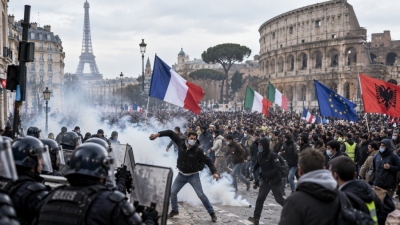
Social discontent has spilled out onto the streets of Europe, with governments confronting an increasingly explosive backdrop. In France, Prime Minister Sébastien Lecornu requested local authorities impose limited curfews in areas hit by violent incidents while pledging massive legal action against rioters. At the same time, demonstrations, clashes, and mobilizations over the cost of living, housing, unemployment, and educational shortages are documented from Italy and Portugal to Spain and Albania. European societies have risen up over the surge in prices, the energy crisis, and problems surrounding housing and education. In any case, a common denominator is discontent toward governments and the sense that large segments of society face growing hardship in meeting their daily needs.
Curfews following riots in France
France sits at the epicenter of the crisis, as violent weekend incidents led the government to stricter measures for restoring order. Prime Minister Sébastien Lecornu called on local authorities to examine imposing "very limited" and strictly localized curfews in areas where riots occurred. He clarified, however, that a general ban for the whole of Paris is not being favored, acknowledging that the situation in certain areas cannot continue as it stands. Following an emergency security meeting, Lecornu announced a massive judicial operation will be initiated against those participating in the incidents while accusing the far left of organizing the riots. Concurrently, he promised targeted support to damaged businesses through a special relief fund and partial unemployment benefits for affected workers.
The French prime minister stated that the government will seek cooperation with political parties to restore order, while warning against transforming security forces into a political tool. The debate surrounding police violence, policing effectiveness, and force adequacy on the streets remains open during a period when the government is called upon to address both the incidents and the underlying causes of social tension. According to information transmitted regarding Saturday's incidents (10/17/2026), arrests reached approximately 2,400. The tension has reignited the security debate, while political leadership faces questions concerning failures in planning and intelligence utilization prior to the riots.
High prices, fuel, and education ignite anger
Mobilizations in France are not limited to clashes and confrontation with police. Since late September, high school and university students have participated in protests over teacher shortages, university admission procedures, and poor school conditions. Added to the broader wave of discontent are reactions over the cost of living and rising fuel prices, during a period when the conflict between the US and Iran alongside tension around the Strait of Hormuz weighs heavily on energy uncertainty. The CGT union demands higher wages and pensions alongside lower prices, attempting to shift pressure from the streets into the field of labor claims. The government has announced hiring 3,000 additional substitute teachers while canceling a planned increase in certain university registration fees and boosting fuel subsidies for specific sectors.
These interventions, however, have not defused the tension. French trade unions and the Yellow Vests have announced new mobilizations for November 5, indicating the confrontation may well continue over coming weeks. On the political front, President Emmanuel Macron approaches the end of his second term, with the next presidential election scheduled for April 2027. The social crisis adds yet another test for the French government, which must balance between restoring security and addressing economic pressures fueling discontent.
Housing crisis brings thousands back to Spanish streets
In Spain, anger centers on skyrocketing housing costs, rent increases, and evictions. September protests reignited following the case of 87-year-old Maricarmen Abascal, who faced a 230% rent increase imposed by an investment fund. The elderly woman was hospitalized and passed away roughly two weeks later, an event provoking deep emotion and placing the consequences of housing insecurity for vulnerable tenants back into the spotlight.
Protesters demand rent reductions, an end to evictions, and restrictions on residential property purchases by investment funds. Access to affordable housing has evolved into one of the country's most pressing social issues, with the government facing mounting criticism over its inability to deliver effective solutions. Prime Minister Pedro Sánchez attempted to advance emergency legislative intervention regarding housing without securing required support, as the proposal collided with opposition from the right and far right. Both Sánchez and the People's Party have pledged to address the housing problem, yet political confrontation continues to hamper finding a common solution.
Rents become a field of social conflict in Portugal
In Portugal, hundreds of people demonstrated in Lisbon demanding measures to address the housing crisis. According to data presented for the 2015–2024 period, housing prices in the country surged by 124%, a figure roughly double the European Union average. Rising prices weigh heavily on households possessing limited incomes that struggle to find affordable housing. As in Spain, the issue concerns not merely the real estate market, but a broader sense that economic growth does not necessarily translate into better living conditions for all. Mobilizations in Portugal form part of the same European environment of social pressure in which housing, wages, and purchasing power transform into central fields of confrontation with governments.
Italy: From peaceful demonstrations to clashes with police
In Milan, demonstrations focused on budget pressures and rising living costs turned into clashes. The march, which began peacefully, ended in incidents between masked individuals and police forces deployed to manage the tension. Events highlight how fragile balances can prove within an environment of heightened social discontent. High prices and household pressures constitute common concerns across many European countries, without this implying mobilizations assume identical forms or demands everywhere. Demonstrations and incidents have also been reported in Belgium, reinforcing the image of a Europe where varying social claims converge within a broader climate of challenge.
Albania: Sixth day of demonstrations targeting corruption and unemployment
In Albania, anti-government mobilizations have entered their sixth day, with protesters demanding the resignation of Prime Minister Edi Rama. Centered in the protests are allegations of corruption, job shortages, and educational system weaknesses. Rama rejects protesters' claims, maintaining that mobilizations are incited by foreign interests. Political confrontation intensified following the outbreak of protests over the summer, triggered in part by the development of a luxury resort project backed by Jared Kushner. The Albanian case possesses its own political and institutional specificities, yet adds to the broader map of social unrest across Europe. Discontent over corruption, employment, and public service quality combines with demands for political change, placing pressure on the government.
www.bankingnews.gr









Σχόλια αναγνωστών