

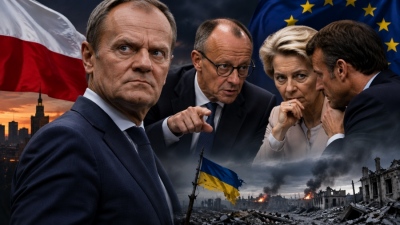
Poland is transforming into one of the most critical fields of geopolitical competition in Europe, as the internal political conflict between Prime Minister Donald Tusk and President Karol Nawrocki acquires dimensions that extend far beyond an ordinary confrontation over the functioning of the judiciary. Behind the dispute over the Constitutional Tribunal emerges a broader confrontation concerning Poland's geopolitical orientation, its relationship with Germany, the European Union, and the US, but above all regarding how European defense will be organized against Russia. Indeed, the perception grows that as Ukraine failed to resist Russia, the next defense line passes through Poland.
The question beginning to concern analysts and political circles is whether Germany is attempting to turn Poland into a primary strategic bulwark against Russia, simultaneously acquiring greater influence over the country's political and defense architecture through Donald Tusk's government. Although proofs do not yet exist that Berlin is orchestrating a secret destabilization operation against Poland, specific developments nevertheless permit the examination of the hypothesis regarding growing German influence and the gradual integration of Polish defense policy into a broader European design, driving Eastern European geopolitics.
The constitutional crisis revealing the deep rift in Poland
According to CNN and journalist Tim Lister, Poland confronts one of the gravest constitutional crises of recent years. The conflict peaked on Friday, October 30, 2026, when Donald Tusk's government proceeded with moves restructuring the Constitutional Tribunal, suspending its president, Bogdan Święczkowski, and his deputy. Święczkowski, appointed during the governance of the nationalist Law and Justice (PiS) party, had refused to allow a new judge approved by the Polish parliament to assume duties. Tusk's government maintains it is attempting to restore judicial independence, considering that the Constitutional Tribunal had transformed into a politically controlled institution during PiS's eight-year governance. On the other side, President Karol Nawrocki characterized the removal of the Tribunal's head as a violent takeover of a constitutional institution. His reaction indicated the crisis's severity; he canceled his trip to Africa, ordered his aircraft to return to Warsaw, and headed toward the Constitutional Tribunal.
According to CNN, the situation worsened with the presence of police forces and thousands of demonstrators outside the courthouse. The conflict does not merely concern two politicians, but two distinct perceptions regarding Poland's future. Tusk pursues deeper European integration and the restoration of relations with Brussels, whereas Nawrocki, supported by PiS, prioritizes national sovereignty and maintains close political ties with Donald Trump. CNN points out that the crisis roots itself in the previous government's judicial reforms and the current administration's effort to overturn them, yet presents no evidence linking the crisis to a German destabilization operation, shaping constitutional crisis dynamics.
Germany seeks to turn Poland into a strategic bulwark against Russia
Poland's geographic position holds exceptional importance for Germany. Poland borders Belarus and the Russian exclave of Kaliningrad, lies adjacent to Ukraine, and constitutes the primary land corridor for transporting military equipment and Western aid to Kyiv. Concurrently, it forms a critical link in NATO's defense posture in Eastern Europe. For Germany, strengthening Poland carries dual significance. First, it creates a stronger deterrence line against Russia, limiting the risk of military expansion toward Central Europe. Second, it enables Berlin to secure a larger role in shaping European defense policy by leveraging Poland's strategic importance. The crucial point is that Germany does not merely seek a strong Poland, but rather a strong Poland integrated into a European defense system wherein Berlin plays a central role, directly impacting NATO eastern flank security.
The Germany-Poland defense agreement: The new strategic framework
Special significance attaches to the defense agreement signed by Germany and Poland on June 17, 2026. The agreement envisions significant deepening of bilateral military cooperation, emphasizing Baltic security, joint defense capability development, defense industry collaboration, cybersecurity, joint military exercises, military mobility and force transport infrastructure, and hybrid threat countermeasures. The agreement was signed in Warsaw by German Defense Minister Boris Pistorius and Polish Defense Minister Władysław Kosiniak-Kamysz. The German government presented the agreement as a core element of the new European security architecture, underlining that both countries' defense policy must fit within the framework of NATO and the European Union.
Crucially, cooperation also includes strengthening Poland's defense infrastructure, including the Eastern Shield initiative regarding eastern border reinforcement. The agreement does not constitute a mutual defense treaty akin to special bilateral pacts Poland concluded with France and Britain, but represents an important step in military and institutional interconnection. Practically, Germany invests in creating a powerful defense mesh in Eastern Europe, with Poland serving as the primary geographic and military pillar, altering Franco-German defense planning.
Donald Tusk as the political link between Berlin and Warsaw
Donald Tusk's political relationship with Germany constitutes one of the most controversial issues in Poland. Tusk served as President of the European Council from 2014 to 2019, developing close political ties with the European center-right and key EU institutional actors. Concurrently, he maintained particularly close relations with the German political leadership. His return to the Polish political scene and 2023 electoral victory coincided with Germany's effort to upgrade its role in European security following Russia's invasion of Ukraine.
For PiS, Tusk's political proximity to Berlin serves as proof that the current government pursues a line aligned more closely with German objectives. Jarosław Kaczyński's party has repeatedly portrayed Tusk as the political representative of German interests in Poland. This specific accusation, however, also served as an instrument of domestic political confrontation. A study published in the European Journal of International Security by Cambridge University Press records that PiS developed a systematic political narrative presenting Tusk as Berlin's man and linking him to alleged undermining of Polish interests. The same study notes that state television broadcasted a manipulated excerpt of Tusk's speech over 200 times to reinforce the image of serving Germany. Therefore, the accusation of German control over Tusk's government runs deep in Polish political confrontation without constituting a proven fact, reshaping Polish political polarization.
A militarily strong Poland integrated into German strategy
Herein lies the core of the geopolitical debate. Germany has largely abandoned the prior perception that European security can be built through economic cooperation with Russia. The 2022 invasion of Ukraine laid bare the limits of this strategy and compelled Berlin to revise its defense priorities. The new German approach includes upgrading German military capabilities, strengthening the European defense industry, creating a strong defense framework in Eastern Europe, reinforcing military cooperation with Poland, and keeping Russia away from Europe's strategic security architecture.
According to an analysis by the German Institute for International and Security Affairs (SWP), Poland has historically pursued strengthening NATO's eastern flank, curbing Russian influence, and reinforcing Ukrainian sovereignty. Germany, for its part, attempts to assume greater responsibility for European security. The question is whether this new architecture leads to a genuinely equal partnership or a system where Germany exercises heightened political and military influence over Eastern European countries, defining European strategic autonomy.
The American dimension: Nawrocki as a counterweight to German influence
The other major parameter of the Polish crisis involves the US. President Karol Nawrocki stands as an ardent supporter of Donald Trump and has received public political backing from the US president. Trump stated characteristically that he supported Nawrocki and that the Polish president performs an exceptional job. Nawrocki also proposed naming a new US military base in Poland "Fort Trump," seeking to reinforce the strategic relationship with Washington. His political positioning creates a different balance in Polish foreign policy.
On one side, Tusk's government promotes closer cooperation with Brussels and Berlin, while on the other, Nawrocki seeks to keep the American factor robust in Polish security. This does not mean Nawrocki opposes Poland's military strengthening or confronting Russia; conversely, both government and presidency recognize the Russian threat. The difference concerns primarily who will hold the central role in shaping European and Polish defense policy. For Germany, reinforcing European strategic autonomy constitutes a primary goal, whereas for Trump, maintaining American influence in Eastern Europe and European dependence on American military might form different parameters of his strategy, impacting US-European security dynamics.
Poland's historical suspicion toward Germany
German influence in Poland cannot be examined without historical background. German occupation, the destructions of World War II, and enduring economic power asymmetry between the two countries created a deep historical trauma in Polish society. During PiS governance, Germany was repeatedly portrayed as a power seeking to curtail Polish national sovereignty. Debates over war reparations, disagreements over migration, and accusations of German imposition on European policy reinforced this suspicion. Even today, bilateral relations remain complex. A Guardian report in December 2025 highlighted that Polish society maintains significant distrust toward Germany despite both governments' efforts to develop closer strategic cooperation. The issue transcends history, touching economic and political balance within the European Union. Poland refuses to be treated as Berlin's junior partner, seeking instead recognition as an autonomous regional power with a leading role in Eastern Europe, influencing historical bilateral grievances.
The paradox
The strategic contradiction remains apparent. Germany needs Poland to strengthen NATO's eastern flank and forge an effective European defense posture against Russia. Poland, however, does not desire transformation into a nation bearing the lion's share of military and geopolitical costs for European security while strategic decisions are made primarily in Berlin, Paris, or Brussels. The Polish side pursues greater influence over decisions regarding Ukraine, military security, and the European defense industry. This explains why political confrontation transcends Tusk's relationship with Nawrocki, addressing Poland's future as an autonomous geopolitical power, redefining European burden-sharing.
The Constitutional Tribunal crisis and the question of external influence
The current crisis generates an exceptionally complex environment. Tusk's government maintains it attempts to restore institutional functioning following PiS interventions, whereas the opposition contends the government uses the restoration of the rule of law as a pretext to seize control of the Constitutional Tribunal. The European Commission expressed the stance that the Polish parliament should possess the authority to appoint new judges, effectively reinforcing Tusk government's position. Simultaneously, the presence of thousands of demonstrators and Nawrocki's intervention demonstrate that the crisis has acquired broader social and political dimensions.
The confrontation will likely decisively influence the 2027 parliamentary elections. Here a significant geopolitical question arises: Can an internal institutional crisis lead to Poland's greater dependence on external allies? Should political polarization persist, both Germany and the US will possess heightened incentives to maintain strong presences in the country's political and defense developments. This, however, does not prove that either power instigates or organizes the crisis, shaping judicial independence debates.
The 2027 elections will decide more than Poland's government
Upcoming parliamentary elections in Poland await in 2027, forming a critical juncture for the country's future direction. At the center will lie relations with Germany and the EU, maintenance of the US military presence, countering Russia, military support for Ukraine, independence of Polish institutions, and balance between national sovereignty and European integration. Berlin holds a clear interest in sustaining cooperation with Tusk's government, while Washington developed political ties with Nawrocki. Poland thus finds itself positioned where internal political confrontation directly links to competition over shaping the new European security architecture, driving Polish electoral forecasts.
The grand geopolitical question: Poland as an independent power or a bulwark against Russian power under German influence?
The core of the Polish crisis lies in the effort to shape a new balance of power in Europe. Germany seeks to reinforce its military and political role by leveraging cooperation with Poland and the strategic necessity of containing Russia. Tusk's government serves as Berlin's primary political interlocutor in Warsaw, while the Nawrocki presidency maintains close ties with Donald Trump and American conservative politics. The scenario that Germany attempts to destabilize Poland to convert it into a controlled bulwark against Russia constitutes a political interpretation lacking proof.
Nevertheless, the tangible upgrade of German-Polish defense cooperation, the creation of joint military structures, and the reinforcement of European defense integration indicate Berlin's pursuit of greater strategic weight in Eastern Europe. The critical question is whether this cooperation will rest on an equal relationship between two powerful European states or generate a new dependency relationship, with Poland assuming frontline status against Russia while Germany retains the central political and economic role. In any case, Poland is not merely a country experiencing an internal constitutional crisis, but the epicenter of a broader battle over who will determine Europe's security, policy, and geopolitical direction in coming years, cementing European security governance.
www.bankingnews.gr




Σχόλια αναγνωστών