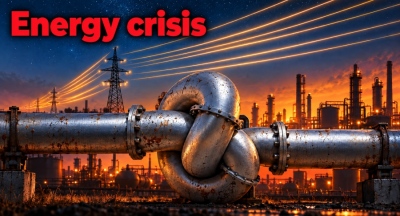
Across the European Union, a progressive economic decline is being experienced, factories are closing or quietly scaling back production. Chemical industries, steelmakers, fertilizer producers, the most energy intensive sectors of the economy, are either migrating outside Europe or shutting down entirely. This is not a cyclical downturn. It is structural decline. Europe has not emerged from the energy crisis of 2022 and will not emerge anytime soon. The most alarming element is not even the crisis itself, but the fact that the European leadership is unable to understand what is happening. Policymakers acknowledge the loss of competitiveness, yet their response is trapped within a flawed economic paradigm. They seek lower energy prices while almost completely ignoring system level costs. With an unshakable belief that politics can overcome physical constraints, they merely redistribute the burden of a declining energy surplus, covering it with elaborate schemes of “policy engineering.” The deepest problem of Europe’s leadership is energy illiteracy.

A slow motion suicide
Slovak Prime Minister Robert Fico described the EU plan for the complete elimination of Russian natural gas as “energy suicide.” A more accurate description would be hard to find. After four years of crisis, Europe learned nothing and continues down the same path at greater speed. Even more ironic is that this self destruction is presented as a bold geopolitical stance. Historian Arnold Toynbee noted that civilizations are rarely destroyed by external enemies, they usually commit suicide. No one, of course, consciously chooses decline. And yet, Europe continues to regard “decoupling” from Russian natural gas as a success, placing its hopes in a “green transition” that is being dismantled before our eyes. It is no coincidence that the peak of optimism for the energy transition, culminating in the Green New Deal in 2019, coincided precisely with the peak of Russian gas supplies to Europe. Germany’s ability to massively subsidize renewable energy sources for two decades was based on the energy surplus provided by cheap Russian gas. The “green luxury” was a byproduct of cheap energy, not a substitute for it.

The flawed doctrine of Brussels
The Spanish philosopher Jose Ortega y Gasset distinguished ideas from beliefs. Ideas are debated and change, beliefs are invisible and structure thought. Europe’s central belief is faith that administrative ingenuity can transcend tangible physical constraints. If the right mix of policies, subsidies, and regulations is found, reality will adapt. Europe endlessly debates policies, but rarely questions the assumptions on which they rest. A second belief is that the economic problem is primarily a problem of prices. Most economic theories were shaped in an era when energy was cheap and abundant, therefore “invisible.” Not because it was unimportant, but because its cost did not constrain economic growth. These very assumptions led Europe into crisis and then determined the response to it.

Redistribution of cost instead of solution
In 2022, prices surged above 300 euros/MWh. The response was not to reduce energy costs, but the irrational redistribution of them, price caps, tariff freezes, windfall taxes, subsidies. A vast administrative system was mobilized not to make energy cheaper, but to conceal who pays the bill. Then came the turn to LNG. New terminals, new interconnections, long term contracts at higher prices. LNG delivers less net energy than pipeline gas and requires energy intensive processes of liquefaction and transport. The cost is enormous, multi year, and largely financed with debt. It does not disappear, it is shifted into the future. Four years later, prices may have declined, but the crisis continues. Energy is now structurally more expensive and policy responses remain the same, subsidies, exemptions, temporary relief. Germany proposes subsidized “industrial electricity prices.” Italy introduces fixed low prices for industry in exchange for commitments regarding production costs. The pattern is clear, a game of cost shifting which of course does not reduce it. The financial system and bureaucracies are extremely effective at obscuring physical reality. Stock exchange prices show market cost, not the real cost of the energy system nor how many real resources it absorbs.

Energy is measured with energy
Energy is required to produce energy. This is the non negotiable fact. No financial invention changes the energy balance. If producing one unit of energy requires nearly one unit of energy, there is no surplus, something understood even by those most unfamiliar with markets. When energy becomes more expensive in real terms, the system does not “detect” it at a single point. It sees it everywhere, lower productivity, deindustrialization, contraction. Everything operates under steadily worse terms. The key concept is ECoE (energy cost of energy). The greater the share of the energy surplus consumed to obtain equivalent energy, the less remains for the economy. This is exactly what Europe is experiencing today.

The illusion of “normalization”
Bloomberg noted in a publication that gas prices returned close to 27 euros/MWh, but the competitiveness of the European economy did not recover. The detail that reveals everything is that consumption is about 20% lower than pre 2022 levels. This is not stability. It is demand destruction. Prices fell because energy intensive industry left. And when industry leaves, it does not return. Giants such as BASF, Dow, and Thyssenkrupp are not threatening to leave. They have already left, fully or partially.

The cultural limit of understanding developments
The think tank Bruegel argues that as renewable energy sources increase, prices will fall. But the text itself admits that fixed costs are skyrocketing, grids, interconnections, subsidies, state mediation. Costs do not decrease. They are simply removed from the headlines. As the epistemologist Thomas Kuhn pointed out, a scientific paradigm determines not only the answers, but also the questions that are allowed to be asked. Europe asks whether prices will fall. It does not ask how much of its economic output energy now absorbs. The belief that Europe can “design” the overcoming of physical constraints is the core of European ideology, perhaps even delusion. Yet no policy suspends the laws of thermodynamics by decree. Vaclav Smil shows that every successful energy transition increased energy density and system productivity. This is the test that Europe is failing. Finally, as Joseph Tainter warned, increasing complexity yields diminishing returns. In Europe, the solutions are extraordinarily complex, but the results meager and the future dark.
www.bankingnews.gr



Σχόλια αναγνωστών