

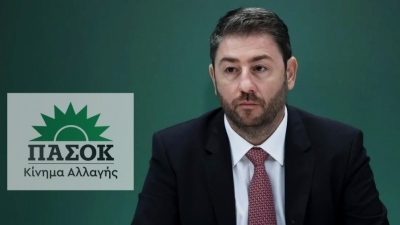
PASOK can serve as the primary pillar of support for Kyriakos Mitsotakis in his effort to remain in a position of power after the next national elections, as oxymoronic as such a scenario may sound.
In a period during which an outright majority for New Democracy appears an unattainable goal, the prospect of a coalition government brings back to the forefront scenarios regarding post-election discussions.
At the center of this discussion stands PASOK and, in particular, its cadres situated in the political Center.
These are figures with whom the prime minister could find points of common understanding, provided that appropriate political and parliamentary preconditions take shape.
And a piece of information: in the coming period, top executives of PASOK will hold a meeting in the form of a dinner to examine all post-election contingencies.
The arithmetic of cooperation and the Samaras factor
For Kyriakos Mitsotakis, the decisive issue will be the electoral outcome and the parliamentary arithmetic that emerges.
A percentage that allows New Democracy to seek a majority with a single partner would limit the need for broader and more complex agreements.
In this case, PASOK could constitute the primary interlocutor of New Democracy, provided of course that its leadership accepts such a prospect.
However, if the necessity arises for a third partner to join as well, things become difficult for Mitsotakis.
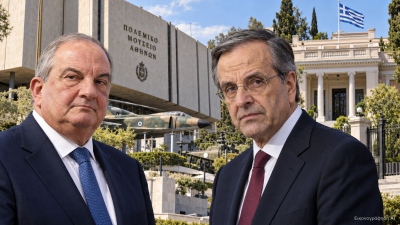
Samaras would not be opposed to cooperation with ND, yet he would impose a veto on the person of the Prime Minister.
He would not accept Mitsotakis. And information suggests that he would agree on more than one individual to assume the Premiership...
The 35% threshold and the limits of an absolute majority
In public discourse, the estimate is also voiced that, if smaller parties remaining outside Parliament collectively gather around 16%, the percentage required for an outright majority could settle near 35%.
However, this arithmetic is not sufficient on its own to secure a governing majority, as the electoral system and seat allocation play a decisive role.
ND stands at 25% in voting intention, and the ceiling projected by certain pollsters is 28%.
Reaching 30% would constitute an extreme overperformance.
How, therefore, will 35% be captured while simultaneously parties outside Parliament aggregate to 16%?
Nevertheless, a proposal was also floated to raise the parliamentary entry threshold to 5%, something that would move in the direction under analysis...
The 25% scenario and the day after
If New Democracy moves near 25%, the equation becomes even more intricate.
In that event, PASOK may not suffice numerically to form a government, leading to discussions over additional parliamentary allies.
Then, the side of Samaras could acquire greater importance in negotiations.
Thus, PASOK emerges as one of the fundamental variables in the post-election equation.
Maximilianos
www.bankingnews.gr







Σχόλια αναγνωστών