

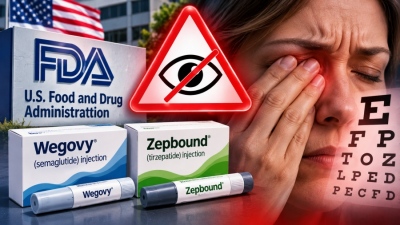
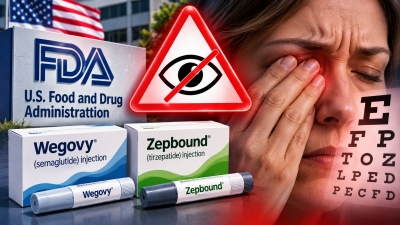
New safety warnings for all GLP-1 drugs are being demanded by the US Food and Drug Administration (FDA), as it has identified evidence indicating a potential increase in the risk of developing a rare eye condition. The decision was announced on Monday and concerns popular medications such as Novo Nordisk's Wegovy and Ozempic, as well as Eli Lilly's Mounjaro and Zepbound. The condition is called non-arteritic anterior ischemic optic neuropathy (NAION) and can cause a sudden decrease in vision, and even permanent loss thereof. However, this is a rare condition, and so far no causal relationship has been proven between its onset and the use of these specific drugs.
Mandatory warning on all GLP-1 drugs
As the FDA announced, manufacturers of all GLP-1 drugs will need to add a warning to their medications' safety information regarding the potentially increased risk of NAION associated with their use. NAION is a condition that can lead to sudden visual deterioration, including permanent loss. It is caused by reduced blood flow to the anterior part of the optic nerve. However, the underlying cause leading to its onset is not fully understood. The FDA clarified that NAION cases have been reported for all GLP-1 products currently on the market. CNBC contacted Novo Nordisk, the company producing Ozempic and Wegovy, as well as Eli Lilly, which is behind Mounjaro, Zepbound, and Foundayo, requesting a comment on the decision.
What clinical trials and patient data showed
The FDA's decision comes following an evaluation of clinical trials, real-world patient data, and published scientific studies. An analysis of 126 clinical trials, involving more than 134,000 patients, recorded 6.4 NAION cases per 100,000 person-years among those taking GLP-1 drugs. In contrast, for patients receiving other treatments or a placebo, the corresponding proportion was 3.8 cases per 100,000 person-years. Simultaneously, several observational studies also identified an increased risk, reinforcing the concerns of the American agency. These data led the FDA to the decision to proceed with a unified safety labeling change for the entire category of GLP-1 drugs.
Citi: Limited impact on drug usage
The FDA's move is expected to attract market attention, but it is estimated that it will not have a significant effect on the use of GLP-1 drugs. According to Citi analysts, the decision to add a warning to all medications in the category is likely to attract attention, but will have a limited impact on the adoption of GLP-1s. As they point out, the development may temporarily cause increased concern among both patients and investors. However, the rarity of NAION, combined with the significant benefits of these drugs, is expected to keep the benefit-risk ratio positive. These benefits include weight loss, better glycemic control, as well as positive effects on cardiovascular and renal health, and on sleep apnea. Citi analysts therefore estimate that the new warning is not expected to lead to substantial changes in drug prescriptions.
The warning for thyroid tumors
GLP-1 drugs have been shown to offer benefits beyond weight loss and blood sugar level control. However, several of them already carry the FDA's strictest safety warning, known as a boxed warning, due to a potential risk of thyroid tumors. Studies have shown that semaglutide, the active substance of Wegovy and Ozempic, as well as tirzepatide, the active substance of Mounjaro, cause tumors in thyroid C-cells in rodents. It remains unknown, however, whether these specific drugs can cause corresponding tumors in humans, including a rare form of thyroid cancer. The FDA's new intervention therefore adds another safety factor to the discussion surrounding the highly popular GLP-1 drugs, without overturning the evaluation of their significant therapeutic benefits thus far.
www.bankingnews.gr











Σχόλια αναγνωστών