
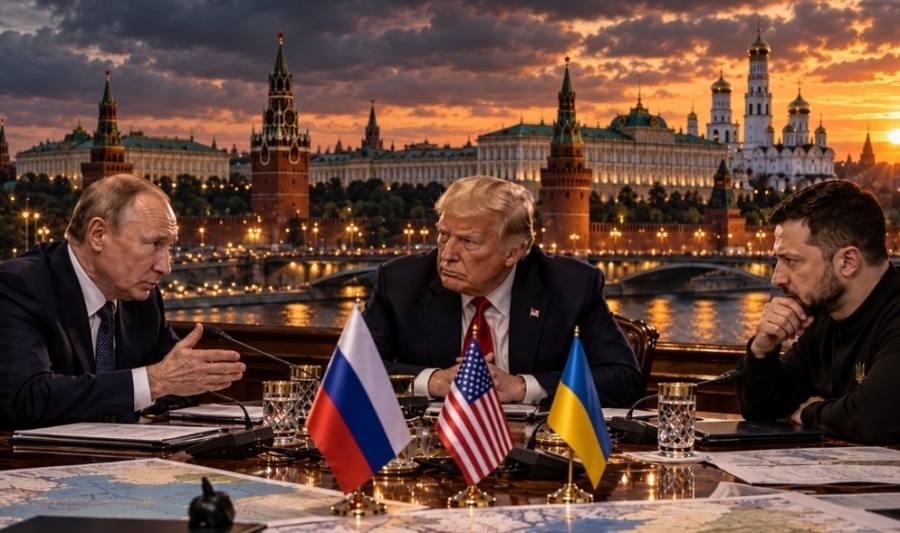
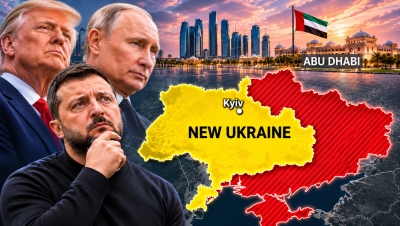
The impending negotiating process in Abu Dhabi brings to the forefront a profound disagreement between Moscow and Kyiv concerning the sequence of actions that could lead to the termination of the war. The Russian side insists that a broader framework of European security must first be agreed upon, followed by proceeding to a ceasefire. Conversely, Ukraine maintains that the cessation of hostilities takes precedence, followed by negotiations regarding security guarantees.
The fear of a repetition of the Minsk model.
For Moscow, the prospect of a temporary truce without explicit and binding guarantees generates the risk of repeating what occurred with the Minsk agreements. Russian concern is that Kyiv and its Western backers will exploit a lull in fighting to regroup their forces, bolster their military equipment, and prepare for a fresh confrontation. In this scenario, Russia could find itself bound by new commitments without having secured corresponding guarantees from the other side.
The Donald Trump factor and pressure from Washington.
The political situation in the US plays a significant role in the progression of talks. Moscow appears to calculate that the window of opportunity for an agreement with Donald Trump is narrowing, as his leverage over the American political system may weaken. The Russian side assesses that an ascendant Democratic Party could lead to a resurgence of American support for Ukraine and closer coordination with European governments.
The new American approach to European security.
The reported pivot in American strategy presents particular interest.
Rather than confining talks to localized ceasefires and territorial settlements, the broader question of a new European security architecture, taking Russian concerns into consideration as well, now appears to be on the table. This specific approach represents a notable departure from previous diplomatic initiatives, without it being clear, however, whether it can lead to concrete outcomes.
Russia dispatches a formidable delegation to Abu Dhabi.
The gravity with which Moscow approaches the talks is reflected in the composition of its delegation.
The matter was deliberated during a meeting chaired by Vladimir Putin, on November 6, with the participation of senior government and military officials.
Preparations involved, among others, Vladimir Medinsky, who is expected to lead the Russian delegation, Yuri Ushakov, Deputy Foreign Ministers Mikhail Galuzin and Sergei Ryabkov, as well as senior officers from Russian military intelligence services.
The message from the Kremlin to the United Arab Emirates.
The presence of such high-ranking officials in the talks is considered indicative of the importance the Kremlin attaches to this initiative. Concurrently, Vladimir Putin publicly expressed his gratitude to the leadership of the UAE for undertaking the organization. This move is interpreted as an indication that Moscow seeks to leverage the meeting not only for the Ukrainian issue, but also to reinforce its diplomatic ties.
The Ukrainian delegation and the limits of negotiations.
From the perspective of Ukraine, the composition of the mission conveys different impressions. The delegation is led by Rustem Umerov, while Kyrylo Budanov, David Arakhamia, Sergiy Kyslytsya, and Vadym Skibitsky also participate. The Chief of the Ukrainian General Staff, Andrii Hnatov, is also expected to take part in the talks. The presence of numerous officials with security and military portfolios reinforces the assessment that Kyiv will focus primarily on the terms of a potential ceasefire.
The role of Steve Witkoff and Jared Kushner.
The American side is expected to be represented by Special Envoy Steve Witkoff and Jared Kushner, close associate and son-in-law of Donald Trump. Their mission is to facilitate an agreement that could represent a major diplomatic triumph for the American president. However, the question remains whether the two negotiators possess the ability to secure a comprehensive agreement encompassing both the Ukrainian question and the future security balance in Europe.
The plan for a new European security architecture.
The fundamental question is whether the talks can genuinely lead to an agreement of historical magnitude comparable to a new conference of the Yalta type.
The prospect of a comprehensive settlement of European security requires the involvement of multiple parties and the resolution of exceptionally intricate problems.
Kyiv, however, does not appear disposed to discuss such a broad framework, as its priority remains an immediate ceasefire.
A ceasefire as a potential diplomatic trick.
According to reports in The Washington Post, the plan under review by Jared Kushner envisions a concurrent agreement on a ceasefire and the initiation of negotiations for a new security architecture in Europe.
Here lies the core concern for the Russian side: a truce can be implemented relatively swiftly, whereas talks on European security risk dragging on for an extended period without substantive conclusion. Thus, Moscow risks accepting a cessation of military operations without securing the guarantees it deems vital.
The negative experience of the Russia-NATO Council.
Another issue prompting reservations in Moscow is the possible revival of a dialogue mechanism akin to the Russia-NATO Council. The Russian side considers that past experience did not prevent the eastward expansion of the Alliance and that consultations failed to ensure substantive protection of Russian interests. For this reason, the notion of a new negotiating structure is met with skepticism.
Europe appears unready for substantive compromise.
European governments appear divided over the expediency of a new dialogue process with Russia. Certain nations consider that Moscow is under mounting military and economic pressure and that there is no reason to offer it significant concessions. Meanwhile, according to reports, limited European delegations may participate, primarily to keep a channel of communication open.
The stance of Emmanuel Macron and French diplomacy.
Emmanuel Macron appears to pursue a more active presence in the process. The Minister for Europe and Foreign Affairs of France, Jean-Noël Barrot, stated that his country will participate in relevant discussions. The French posture indicates that Paris does not wish to be left out of developments, particularly at a time when the future security balance on the European continent is under debate.
The strategic objective of Donald Trump.
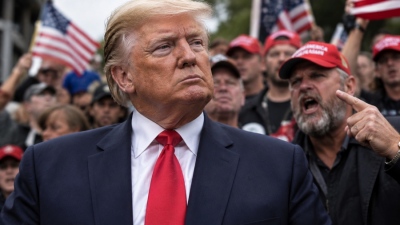
For Donald Trump, an agreement could represent a major political achievement, enabling him to present himself as the leader who accomplished the termination of the war. Even if the agreement proves short-lived, he could argue that its failure to be implemented was due to the inability of Vladimir Putin and Volodymyr Zelensky to reach an understanding. In this manner, he would attempt to shift political responsibility onto the two belligerent parties.
European concerns regarding the participation of Russia.
The prospect of Russian participation in shaping a new European security architecture has provoked reactions across European capitals. According to The Washington Post, Vladimir Putin reportedly viewed the proposal for broader negotiations favorably. Financial Times, for its part, reports that European officials were blindsided by the American initiative. Volodymyr Zelensky described the idea, according to the report, as dangerous.
The economic burden of the Ukrainian conflict on Europe.
One of the most significant factors influencing the posture of Europe is the swelling financial cost of supporting Ukraine. The funding requirements of Kyiv remain exceptionally elevated, with estimates cited in the original report speaking of a need for approximately 70 billion euros over the coming year. Of this, the European Union is reportedly considering covering approximately 46 billion euros.
Frozen Russian assets and European debt.
Within this framework, Brussels is examining the utilization of revenues from frozen Russian assets, alongside the issuance of new joint European bonds. The borrowing option creates additional financial obligations for member states, while intensifying debate regarding the long-term sustainability of funding Kyiv. The economic burden may constitute a decisive factor in future political decisions of the European Union.
European societies exhibit signs of fatigue.
War fatigue is becoming increasingly apparent across European societies as well. Polling data cited by the original report reveals that significant percentages of citizens in France, Germany, Spain, and Italy prefer a swift peace settlement, even if it entails territorial concessions by Ukraine. This trend does not necessarily signify acceptance of Russian positions, but captures the growing desire for an end to the conflict.
Democrats and the continuation of American aid.
On the other side of the Atlantic, the American political landscape remains a critical factor of uncertainty. According to information cited by the original article, Democrats seek the continuation of financial and military assistance to Kyiv, while the allocation of new funds is under consideration. The ability to exert pressure through the federal budget could curtail the maneuvering space of Donald Trump and complicate his effort to reach a deal with Moscow.
Berlin and Brussels reject a deal at the expense of Ukraine.
The German government has voiced clear objections to any agreement between Russia and the US that bypasses the interests of Ukraine and Europe. Defense Minister Boris Pistorius has underlined that such a settlement cannot be deemed acceptable. Taking the same line is the head of European diplomacy, Kaja Kallas, who demands accountability from Russia, reparations for destruction, and the preservation of Ukrainian military capabilities.
The possibility of a new Minsk-style agreement.
The foundational Russian concern is that European governments and backers of Ukraine may temporarily accept an agreement solely to play for time. Such an outcome could lead to a new period of rearmament and military preparation for Kyiv without resolving the fundamental causes of the conflict. In this way, Moscow fears finding itself facing a replay of the previous Minsk model.
Washington remains divided.
American policy displays two differing trajectories. On one hand, the White House attempts to advance a diplomatic solution and shorten the duration of the war. On the other, powerful factions remain within Congress supporting the continuation of military and financial aid to Ukraine. This contradiction risks undermining any mediation effort, as American policy does not appear to possess a unified strategy.
Three potential reasons for the participation of Moscow.
Despite its reservations, Russia has incentives to take part in the Abu Dhabi talks. The first probable aim is to demonstrate to its international partners that it remains open to diplomatic solutions, despite pressures exerted on certain countries to curtail relations with Moscow. The second is to exploit disagreements between the US and Europe, attempting to drive wedges into the Western camp and secure diplomatic or economic dividends.
The need for a temporary breather on the Russian side as well.
There is, however, a third plausible explanation. Moscow may judge that continuing military operations carries a heavy toll for its side as well. Viewed through this lens, participating in negotiations could serve as a means to secure a temporary pause in fighting, without abandoning fundamental Russian aims. This would explain why Russia might appear more amenable to a process that, at least on first reading, does not guarantee the fulfillment of its demands.
The major question for the day after.
The central conclusion is that the talks in Abu Dhabi are not unfolding within an atmosphere of genuine convergence of interests. Moscow pursues a comprehensive overhaul of security terms in Europe, whereas Kyiv sets an immediate ceasefire and guarantees for its future security as top priorities. Europe remains divided and the US does not appear unified regarding the strategy it ought to follow.
An agreement or yet another postponement of the conflict?
The prospect of a genuinely viable peace agreement continues to confront formidable obstacles. If negotiations are confined to a temporary truce lacking substantive political and strategic guarantees, there is a risk they will simply constitute a regrouping phase for the parties involved. For Russia, the critical issue is not exchanging its strategic aims for promises unbacked by concrete commitments. For Ukraine, correspondingly, the objective is ensuring that any agreement will not leave it exposed to a fresh military clash.
Abu Dhabi may represent the launchpad for a substantive diplomatic process, or merely another waypoint in a war deferred in time without being resolved. What is truly at stake is not merely who accepts a ceasefire first, but who will dictate the terms of the next European security architecture.
www.bankingnews.gr

Σχόλια αναγνωστών