

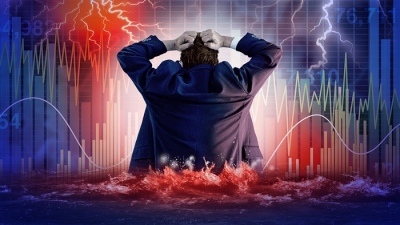
The most serious stock market crash in history will come in 2026, according to the well known economist Harry Dent, founder of HS Dent Investment Company.
Dent predicts that the current stock market bubble, which has lasted almost 17 years, will burst, causing the stock market to fall by as much as 90%.
He characterizes it as the worst market environment since the era of the Great Depression.
It is worth noting that Dent rejects the view that “speculative overheating is confined to artificial intelligence (AI)”.
He argues that stocks, real estate and digital assets are all trapped in a debt driven “superbubble”.
Dent explains: “This bubble is different, because it expanded rapidly from early 2009 and did not allow a recession to fully clear debt and various problems.
Instead, it took off immediately and continued until today”.
The American economist identifies the beginning of this cycle in the period after the 2008 financial crisis and believes that policymakers prevented the natural reset of the economy through monetary interventions.
Specifically, the global economy should have gone through a longer downward adjustment, like the 1930s, but aggressive fiscal spending accelerated the expansion process.
Dent states that the beginning of 2026, and especially January, will constitute a critical period to determine whether the bubble will finally burst or whether it will be extended for another year.
The reason is that, based on historical experience, strong stock market performance in the first week and the first month of January often foreshadows strong market performance for the entire year, whereas weak January performance will further confirm his pessimistic assessment.
Dent emphasizes that every major speculative bubble ultimately ends in catastrophic losses and believes that this time will be no exception.
As he says: “The bubble will inevitably burst because this time it has already swollen to an irrational degree”.
Dent concludes that the only asset likely to “survive” is US government bonds, “because they can print money to repay”.
At this point, the economist appears to disagree with other well known economists, including Peter Schiff.
Schiff recently predicted an unprecedented collapse of the US dollar in 2026.
Precarious crossroads
The truth is that the global financial system is at an extremely precarious crossroads.
A 17 year debt superbubble, inflated by monetary interventions after 2008, is now balancing on the edge of collapse.
However, amid this impending crisis, strategic defensive positioning and disciplined asset allocation offer a path to risk mitigation.
The roots of the crisis lie in the period after the 2008 collapse.
Central banks, led by the US Federal Reserve, injected trillions into global markets to stabilize the system.
Instead of allowing a natural deleveraging process, these interventions artificially supported asset prices, creating a speculative superbubble.
Bitcoin, often considered a barometer of extreme market conditions, has followed a similar pattern.
Historical data show that Bitcoin rarely records a new high after the peak of a four year cycle, with declines of at least 77% following such peaks.
By 2026, Dent predicts that Bitcoin could fall to 30.000 dollars, or even to 15.600 dollars, if the bubble bursts.
The artificial intelligence sector, and especially stocks such as NVIDIA, has turned into the new “Cisco” of the dot com bubble era, with valuations detached from fundamentals, according to Dent.
Although the long term potential of AI is indisputable, current prices presuppose perpetual growth in a world where debt fueled bubbles rarely end without a violent correction.
Indications of an impending correction
January 2026 will be a critical test, Dent notes. Why?
Historically, a weak January signals downward momentum, while a strong start reinforces upward trends.
At the same time, US government bonds, a traditional safe haven in times of crisis, are at the center of conflicting narratives.
Dent argues that the ability of the US government to “monetize” debt makes bonds one of the few assets that will survive the crash.
Global macroeconomic indicators also show increased fragility. US federal debt now exceeds 120% of GDP, while the risk of corporate defaults has reached its highest level since 2008, at 9,2%.
The need to refinance 9 trillion dollars of debt in 2025 has already pushed 30 year bond yields to 4,98%, signaling weakening demand for US debt.
All of this suggests a system under intense pressure, where even small shocks can trigger cascading failures.
Strategic defensive positioning for 2026
As many economists agree that the 2026 crash is approaching, tactical asset allocation must prioritize resilience over growth.
The tactical allocation model of Invesco (October 2025) points to a contraction regime, with a strong preference for fixed income over equities and an overweighting of quality and duration.
This approach reflects a cautious stance amid declining global risk appetite, as captured by the Global Risk Appetite Cycle Indicator (GRACI), according to Invesco.
GMO analysis reinforces this defensive shift.
Investors are called upon to reduce their exposure to AI driven equities and reallocate capital toward non US markets, deep value stocks and liquid alternative investments.
These sectors offer more attractive valuations and a better risk return profile in a potential downside scenario.
Correspondingly, BlackRock proposes a redefinition of diversification, with a combination of liquid alternatives, digital assets and international equities, in order to reduce volatility.
Practical defensive strategies for 2026
Shift to high quality fixed income: US government bonds, TIPS and emerging market bonds offer yield and downside protection. Despite discussions about the long term sustainability of the dollar, its immediate role as a reserve currency ensures liquidity in times of crisis, according to Cambridge Associates.
Diversification beyond US equities: Non US markets, especially in Asia and Europe, offer exposure to growth without the speculative burden of US AI stocks, according to GMO.
Emphasis on deep value stocks and defensive sectors: Utilities, healthcare and consumer staples, sectors with stable cash flows and low leverage, historically outperform during correction periods, according to market analysts.
Utilization of liquid alternative investments: Hedge funds, private credit and real assets such as gold can act as a buffer against equity market volatility, according to BlackRock.
In conclusion, the explosion of the 17 year debt superbubble is not a question of if, but when.
By adopting a defensive stance, with emphasis on fixed income, geographic diversification and avoidance of speculative excesses, investors can navigate the storm.
As indicated by Dent’s warnings and the 2025 asset allocation models, the key to survival in 2026 lies in recognizing the fragility of today’s system and taking timely, decisive measures to protect capital.
www.bankingnews.gr











Σχόλια αναγνωστών