

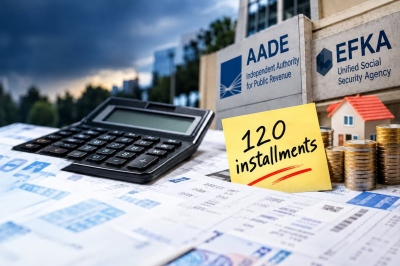
A second chance for households, professionals, and enterprises unable to service old overdue debts totaling 95 billion euros is provided by the new framework of up to 120 installments for debts toward the State and EFKA.
The new private debt framework, redesigned following weak interest in the existing 72-installment scheme, expands both the number of installments and the eligibility timeframe for debts that can be included, while concurrently allowing those already enrolled in the 72-installment plan to transition to the new arrangement.
The primary benefit is the reduction in the monthly burden, at a juncture when individuals and enterprises, predominantly small and medium-sized businesses, continue to confront the impacts of the energy crisis, elevated inflation, and significant operational cost increases.
The objective is to render monthly installments more manageable for debtors struggling to meet their obligations. However, extending the repayment period carries a price, as clearing debts over more installments entails a larger overall interest burden across time.
The new regime
Overdue liabilities that became overdue up to and including December 31, 2024 can be included in the scheme, provided they are not under an active settlement on September 30, 2026. The minimum monthly installment is set at 30 euros, with the interest rate standing at 5.84%. The deadline for submitting applications is extended until June 30, 2027, with a special provision for the approximately 35,000 debtors already enrolled in the 72-installment plan. Upon application, they may transfer their remaining debt balance to the new 120-installment scheme. The transition is not automatic.
What changes from 72 to 120 installments
The first change is the repayment period. From 72 months, the duration now extends up to 120 months, meaning up to ten years. In parallel, the eligible timeframe of debts expands. The previous framework covered debts that had become overdue up to December 31, 2023, whereas liabilities that became overdue throughout 2024 are now included. The reference date checking whether the debt is under an active settlement also changes. From April 20, 2026, it moves to September 30, 2026.
How much the monthly installment drops
The greatest immediate benefit for the debtor is the smaller monthly payment. For instance, on a debt of 5,000 euros, the installment is estimated at approximately 82.50 euros under a 72-month repayment. Under 120 installments, it drops to roughly 55 euros per month. For a debt of 10,000 euros, the monthly installment drops from around 165 euros under 72 installments to approximately 110 euros under 120 installments. On a larger debt of 25,000 euros, the installment falls from around 412 euros under 72 installments to about 276 euros under 120 installments. The difference, therefore, can be significant for the daily cash flow of a household or enterprise.
The trap of more installments
A lower monthly installment, however, has another side. As the duration increases, the total amount to be paid rises due to interest charges. For example, on a debt of 10,000 euros, total payments stand at approximately 11,878 euros under 72 installments and at 13,226 euros under 120 installments. This means the additional interest burden amounts to 3,226 euros.
For a liability of 20,000 euros, total payments amount to approximately 23,756 euros under 72 installments and 26,452 euros under 120 installments. That is, the additional interest charge reaches roughly 3,756 euros under 72 installments and 6,452 euros under 120 installments.
Consequently, 120 installments decrease the monthly payment but increase the overall cost of the settlement.
Who qualifies and who is excluded
The settlement does not cover all debts. Debts created from January 1, 2025 onward cannot be included in the 120 installments. For these, the standard settlement of up to 24 installments remains applicable. Furthermore, to join the new scheme, an applicant must:
- have no other unsettled overdue liabilities, or have them settled through lawful means,
- have submitted the mandatory income tax returns for the past five years,
- have no final criminal conviction for tax evasion or smuggling.
It is also critical that the settlement concerns liabilities not under an active arrangement on September 30, 2026, with the exception of those already enrolled in the previous 72-installment plan who choose to migrate to the 120-installment option.
Enrolling in the 120-installment plan does not mean the debtor can leave their remaining obligations unpaid.
The 240-installment alternative
For debtors carrying a heavier overall debt load, the out-of-court workout mechanism is also available, through which, subject to stipulated conditions, liabilities toward the State, EFKA, banks, and servicers can be restructured into up to 240 installments. The out-of-court framework has also broadened, with the eligibility threshold lowered to 5,000 euros.
The benefits
Enrolling and remaining compliant with the settlement offers the debtor a range of benefits, as:
- A tax clearance certificate is issued,
- Criminal prosecution is suspended for the duration of compliance with the settlement and, upon full repayment, criminal liability is extinguished,
- Enforcement of new compulsory measures and the continuation of forced execution on claims, movable assets, and real estate are suspended,
- Third-party garnishments do not seize future claims of the debtor, provided they concern exclusively settled liabilities and the relevant release decision is communicated to the third party.
Low interest
The 72-installment scheme, launched last July, did not attract the expected number of debtors, prompting the government to expand the repayment window and grant individuals and enterprises more options to resolve old debts. Under the new arrangement, debtors gain greater flexibility regarding the number of installments and repayment horizon.
The necessity for a more adaptable framework demanded by the market becomes even more pronounced when considering the scale of private debt toward the State. Overdue debts to the Tax Office and social security funds now exceed 167 billion euros, with 114.5 billion euros of these relating to liabilities toward the tax administration.
Marios Christodoulou
www.bankingnews.gr











Σχόλια αναγνωστών